What UW–Madison’s AI Recycling Assistant Is Revealing About How We Sort Waste
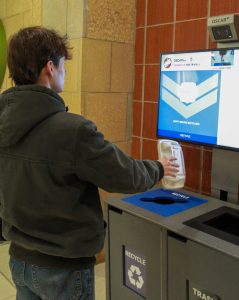
If you’ve been in Union South or Memorial Union lately, chances are you’ve met Oscar. Oscar Sort is UW–Madison’s new AI waste and recycling assistant, introduced by the Office of Sustainability’s Zero Waste Team to improve recycling accuracy on campus. If you hold up a waste item to Oscar Sort’s cameras, it’ll identify it and point you to the correct bin.
Often, which bin an item goes in isn’t intuitive. If you have a to-go coffee, you might assume you can throw it in the recycling bin when you’re finished drinking it. But all of this depends on precisely which coffee cup you have. For example, both the lid and cup of an Aldo’s iced coffee cup are recyclable if empty, but for a Peet’s hot cup, you’d recycle the sleeve and cup, but toss the lid, stopper, and stir stick.
 These are the situations Oscar Sort is designed to help users navigate; its software is trained to detect items specific to UW–Madison’s campus, and the interactive screens nudge users toward the right bin, which supports better recycling outcomes. The data they produce also opens the door to multidisciplinary learning and applied research opportunities, turning UW–Madison into a living lab where infrastructure, operations, and research can come together to advance sustainability on campus.
Ultimately, Oscar Sort was introduced to help us reach our zero-waste goals. But is it succeeding?
Ben Schweitzer, a student in Computer Science and Data Science, aimed to find out. The Oscar Sort units provide waste disposal data that’s never been accessible before, and Schweitzer analyzed the data to compare disposal correctness rates, track trends over time, and identify key sources of contamination.
Schweitzer’s report, entitled Sorting Smarter: What UW–Madison’s Oscar Sort Data Reveals About Campus Recycling, collected data from January 14th through April 8th, 2025, and found there’s been a nearly 10% improvement in waste sorting correctness. However, recycling correctness consistently lagged behind trash correctness, suggesting recycling bin contamination will be the big hurdle on the way to our zero-waste goal.
The report utilized data from the four Oscar Sort units deployed at Memorial Union, Union South, Gordon Dining & Event Center, and Dejope Residence Hall, and found that Union South has the best waste sorting of the four Oscar Sort devices, even though it lags behind Gordon’s in absolute number of disposals. Schweitzer notes that “both the highest trash and recycling correctness rates come from this location,” and “its overall contamination rate is about 8% lower than the overall contamination rate of all four devices combined.”
These are the situations Oscar Sort is designed to help users navigate; its software is trained to detect items specific to UW–Madison’s campus, and the interactive screens nudge users toward the right bin, which supports better recycling outcomes. The data they produce also opens the door to multidisciplinary learning and applied research opportunities, turning UW–Madison into a living lab where infrastructure, operations, and research can come together to advance sustainability on campus.
Ultimately, Oscar Sort was introduced to help us reach our zero-waste goals. But is it succeeding?
Ben Schweitzer, a student in Computer Science and Data Science, aimed to find out. The Oscar Sort units provide waste disposal data that’s never been accessible before, and Schweitzer analyzed the data to compare disposal correctness rates, track trends over time, and identify key sources of contamination.
Schweitzer’s report, entitled Sorting Smarter: What UW–Madison’s Oscar Sort Data Reveals About Campus Recycling, collected data from January 14th through April 8th, 2025, and found there’s been a nearly 10% improvement in waste sorting correctness. However, recycling correctness consistently lagged behind trash correctness, suggesting recycling bin contamination will be the big hurdle on the way to our zero-waste goal.
The report utilized data from the four Oscar Sort units deployed at Memorial Union, Union South, Gordon Dining & Event Center, and Dejope Residence Hall, and found that Union South has the best waste sorting of the four Oscar Sort devices, even though it lags behind Gordon’s in absolute number of disposals. Schweitzer notes that “both the highest trash and recycling correctness rates come from this location,” and “its overall contamination rate is about 8% lower than the overall contamination rate of all four devices combined.”
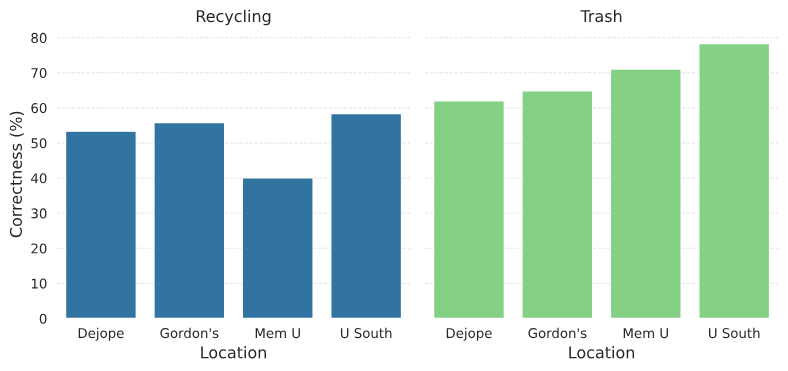 As Schweitzer notes, “any kind of waste stream contamination is harmful,” but “contaminating the recycling bin is worse than the trash bin.” Any recycling contamination means multiple items in the bin will be soiled and unable to be recycled. With Oscar Sort, trash correctness was consistently better than recycling correctness. Plastic lids and plastic cups made up 30% of all recycling contaminants with Oscar Sort, as people don’t know that lids and cups often need to be separated, or that recyclable containers have to be completely clean and free of food contamination. These gaps emphasize the need to create better signage to prevent contamination.
As Schweitzer says, “The Oscar Sort machines are amazing tools, but they cannot do the work for us.” He hopes that we can use the findings from this report to “take a second to stop and think any time we throw something away” so that we can “shape the sustainability of our campus.”
The report shows us the early impacts of Oscar Sort and provides helpful behavioural findings as the units become more established on campus. With more people aware of common contaminants and Oscar Sort’s strengths and weaknesses, hopefully we can take actions such as increased signage, better packaging choices, and education on separating food from containers could reduce contamination and promote a more sustainable campus.
By: Laleh Ahmad
As Schweitzer notes, “any kind of waste stream contamination is harmful,” but “contaminating the recycling bin is worse than the trash bin.” Any recycling contamination means multiple items in the bin will be soiled and unable to be recycled. With Oscar Sort, trash correctness was consistently better than recycling correctness. Plastic lids and plastic cups made up 30% of all recycling contaminants with Oscar Sort, as people don’t know that lids and cups often need to be separated, or that recyclable containers have to be completely clean and free of food contamination. These gaps emphasize the need to create better signage to prevent contamination.
As Schweitzer says, “The Oscar Sort machines are amazing tools, but they cannot do the work for us.” He hopes that we can use the findings from this report to “take a second to stop and think any time we throw something away” so that we can “shape the sustainability of our campus.”
The report shows us the early impacts of Oscar Sort and provides helpful behavioural findings as the units become more established on campus. With more people aware of common contaminants and Oscar Sort’s strengths and weaknesses, hopefully we can take actions such as increased signage, better packaging choices, and education on separating food from containers could reduce contamination and promote a more sustainable campus.
By: Laleh Ahmad
A student uses an Oscar Sort system by holding an item in front of its AI-powered camera.
Average trash and recycling correctness rates across the four Oscar Sort locations.