Fourth-annual Sustainability Symposium highlights links between sustainability and health
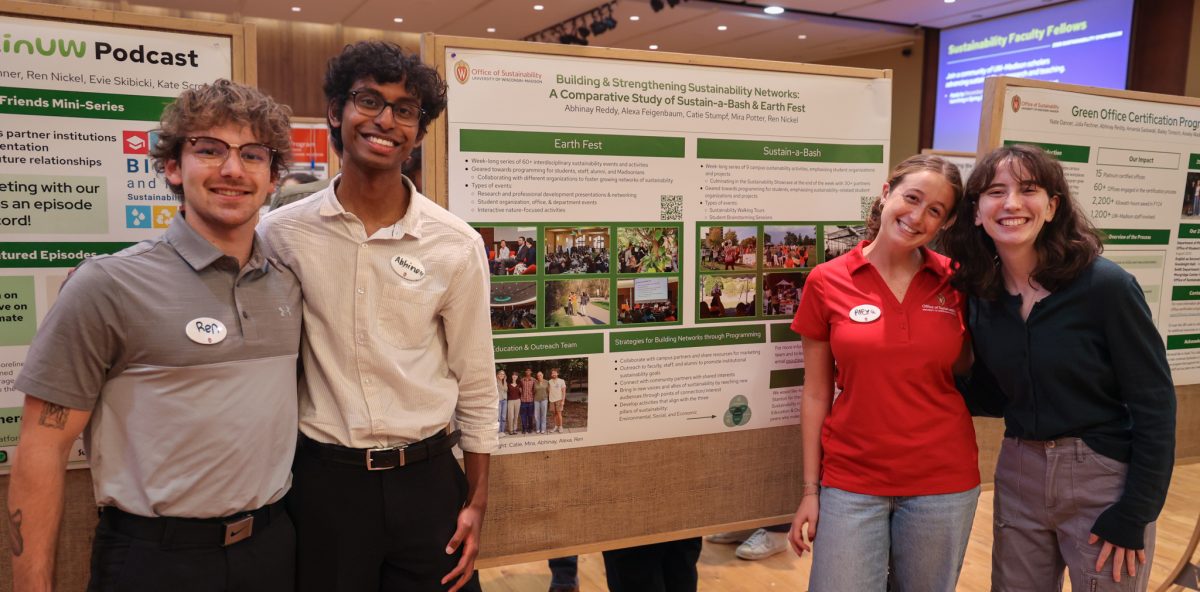
The fourth-annual Sustainability Symposium opened with Paul Robbins, Dean of the Nelson Institute for Environmental Studies, crediting students for the strides UW–Madison has made in sustainability, saying it was because they “would not leave this alone.”
He noted that alongside the university’s net-zero goal, zero waste commitment, and RISE–EARTH initiative, UW–Madison recently earned its first STARS Gold rating — a significant milestone for campus. STARS, the Sustainability Tracking, Assessment & Rating System™, evaluates how universities perform across academics, research, engagement, and operations. Robbins emphasized that events like the Symposium help make that progress visible, bringing forward the research and campus-wide efforts behind the achievement.
This sentiment was echoed by Dr. Andrea Hicks, director of sustainability education and research, who noted how wide-reaching sustainability work is at UW–Madison.
“If you are in this room, I guarantee you do something on this campus or have an interest that falls under the tent of sustainability,” she said. “We are very much into building a bigger tent to serve everyone.”
The Symposium was hosted in partnership with Facilities Planning & Management; the Nelson Institute for Environmental Studies; the School of Human Ecology, University Lectures; the Center for Health, Energy, and Environmental Research; and the UW Environmental Awareness Fund.
 A Healthier Future
The keynote for this year’s Symposium was Dr. Adele Houghton, whose work focuses on the intersection of buildings, public health, and climate change.
Houghton is a member of the American Institute of Architects College of Fellows and received a Doctor of Public Health degree from Harvard University, where she also teaches. Her book, Architectural Epidemiology, proposes a novel method for architectural design: combining neighborhood-scale environmental health data with participatory community engagement to maximize a building’s positive ripple effect on community and planetary health.
The problem with green building design, according to Houghton, is that a building is currently treated like it’s “floating out there in space all by itself.” The larger systems — economic, environmental, political — are not given enough attention. Whenever the built environment is changed, these systems are affected too. Architectural epidemiology seeks to address these problems, acknowledging that architecture makes real changes to natural and physical environments, which have to take more social and ecological factors into account to substantially improve public health outcomes.
A Healthier Future
The keynote for this year’s Symposium was Dr. Adele Houghton, whose work focuses on the intersection of buildings, public health, and climate change.
Houghton is a member of the American Institute of Architects College of Fellows and received a Doctor of Public Health degree from Harvard University, where she also teaches. Her book, Architectural Epidemiology, proposes a novel method for architectural design: combining neighborhood-scale environmental health data with participatory community engagement to maximize a building’s positive ripple effect on community and planetary health.
The problem with green building design, according to Houghton, is that a building is currently treated like it’s “floating out there in space all by itself.” The larger systems — economic, environmental, political — are not given enough attention. Whenever the built environment is changed, these systems are affected too. Architectural epidemiology seeks to address these problems, acknowledging that architecture makes real changes to natural and physical environments, which have to take more social and ecological factors into account to substantially improve public health outcomes.
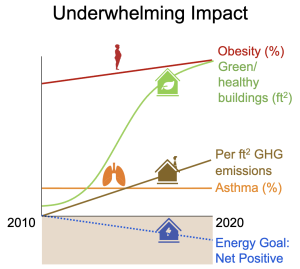 Although there has been “exponential growth” in the square footage of green buidlings globally, Houghton began investigating why this increase wasn’t having more impact on public health outcomes and emissions reductions. She focussed on climate hazards in Austin, Texas, and compared them to Chicago, Illinois., and found that the green buildings are rarely built in the neighborhoods with the highest vulnerability — areas with poor infrastructure and the worst natural hazards.
Building on Hicks’ comments, Houghton said architectural epidemiology is “a transdisciplinary approach” in which “every person in this room would have a role to play.” Houghton’s talk shows how interdisciplinary design and data can work together to improve both human and planetary health. The next speakers, Dr. Cindy Hsin-Liu Kao and Jingwen Zhu, used sustainable textile design to make the same point.
Kao is an associate professor at Cornell University and was joined by her PhD student, Jingwen Zhu. Kao directs the Hybrid Body Lab and conducted a sustainable smart textile workshop to engage with participants. The lab has an interdisciplinary team that spans computer science, mechanical and chemical engineering, and all types of design.
The lab invents materials, processes, and tools for crafting technology on and into the body surface, with a variety of applications. One such application is personalized and conformable medical devices like Medinet, which is a fabric-based device that can help people with hand edema achieve motion.
Although there has been “exponential growth” in the square footage of green buidlings globally, Houghton began investigating why this increase wasn’t having more impact on public health outcomes and emissions reductions. She focussed on climate hazards in Austin, Texas, and compared them to Chicago, Illinois., and found that the green buildings are rarely built in the neighborhoods with the highest vulnerability — areas with poor infrastructure and the worst natural hazards.
Building on Hicks’ comments, Houghton said architectural epidemiology is “a transdisciplinary approach” in which “every person in this room would have a role to play.” Houghton’s talk shows how interdisciplinary design and data can work together to improve both human and planetary health. The next speakers, Dr. Cindy Hsin-Liu Kao and Jingwen Zhu, used sustainable textile design to make the same point.
Kao is an associate professor at Cornell University and was joined by her PhD student, Jingwen Zhu. Kao directs the Hybrid Body Lab and conducted a sustainable smart textile workshop to engage with participants. The lab has an interdisciplinary team that spans computer science, mechanical and chemical engineering, and all types of design.
The lab invents materials, processes, and tools for crafting technology on and into the body surface, with a variety of applications. One such application is personalized and conformable medical devices like Medinet, which is a fabric-based device that can help people with hand edema achieve motion.
 Spotlighting Campus Sustainability
This year’s Symposium brought together hundreds of attendees, 15 lightning talks, and nearly 50 posters. Presentations from faculty, staff, and students spanned a variety of themes such as waste reduction, green buildings, sustainable fuel, and public health.
Spotlighting Campus Sustainability
This year’s Symposium brought together hundreds of attendees, 15 lightning talks, and nearly 50 posters. Presentations from faculty, staff, and students spanned a variety of themes such as waste reduction, green buildings, sustainable fuel, and public health.
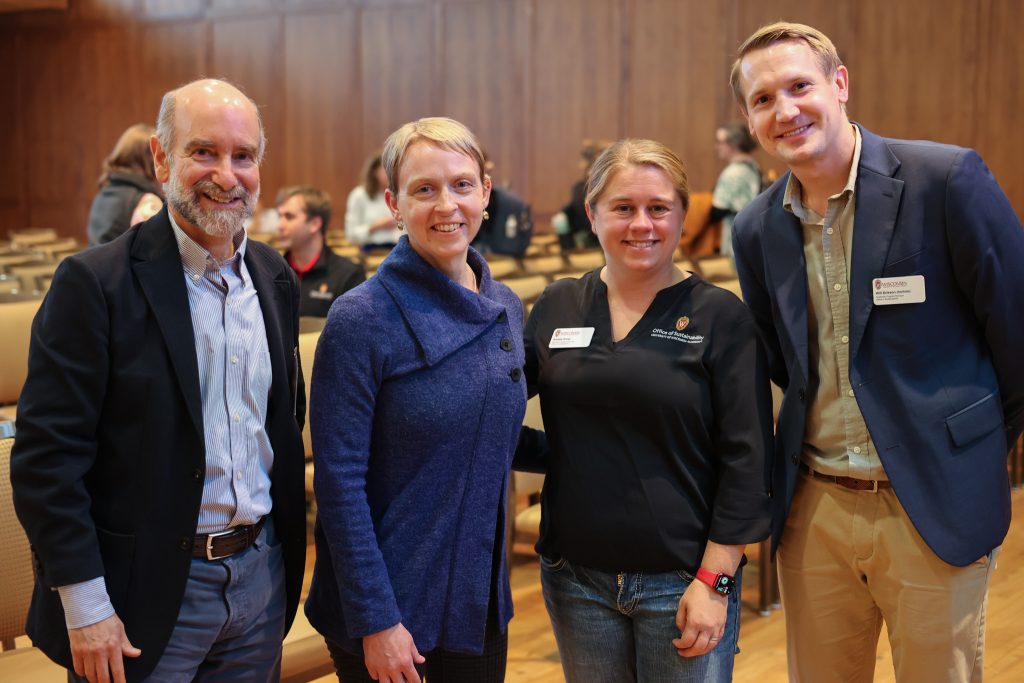
From right, Symposium organizer Will Erikson poses for a photo with Drs. Andrea Hicks, director of sustainability education and research; keynote speaker Adele Houghton; and Jonathan Patz, director of the Global Health Institute
Houghton’s “Underwhelming Impact” graphic showing gaps between green-building growth and health or emissions outcomes.
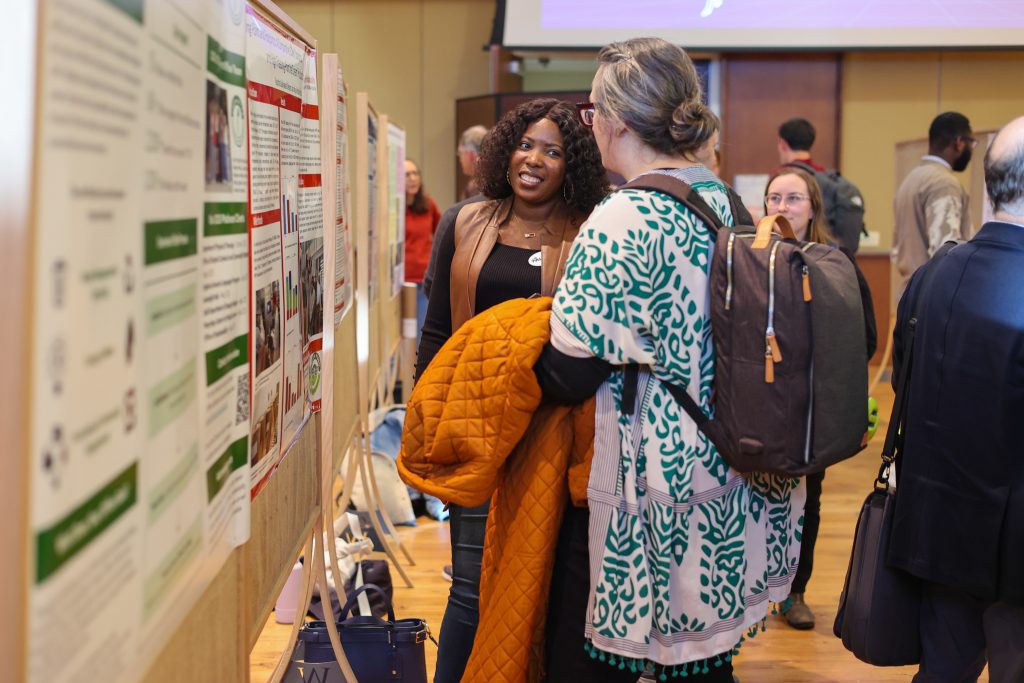
Faustina Sekyere discusses her research with an attendee during the Sustainability Symposium poster session.
“We in America spend about 90% of our time indoors. That’s a lot of time spent in buildings. But what are our buildings teaching us? Have you ever been in a sustainable building? Spoiler alert, we’re in one.” -Dr. Erin Hamilton from the School of Human EcologyMany of the talks highlighted the value of sustainability research and how it can improve both human and planetary health. Sustainable buildings, beyond the physical health impacts that Houghton mentioned, “can also do something really subtle and powerful: they can teach.” Hamilton explained that “awareness of building sustainability” is linked to “greater occupant satisfaction with the built environment, stronger place attachment, and increased behaviors that support the building’s performance.” In the same vein, there were talks about “Preventing Bird Collisions on the UW–Madison Campus,” “How Academics Propelled UW–Madison to STARS Gold,” and “What percent green space is the UW–Madison campus?” showing the importance of research on our built environment. Our academic and research successes in sustainability also shone through in the 15 lightning talks and the various posters on topics such as “Sustainable Design of Plastic Waste Management,” “Transforming Vacant Buildings into Sustainable Housing,” and “Solar Energy at the Arboretum.” With so many presentations from students showing their sustainability projects, Robbins’ words about students not leaving sustainability ring true. As Pulsinelli said during her lightning talk on bird collision prevention, “projects like this make students like me feel that we can make a real difference in the world and have a more sustainable future.” UW–Madison’s fourth annual Sustainability Symposium shows us how sustainability initiatives come from all disciplines and corners of campus, and indeed, that they must for UW–Madison to meet its long-term sustainability goals and continue to be a regional leader on sustainability and benefit our wider community. By: Laleh Ahmad