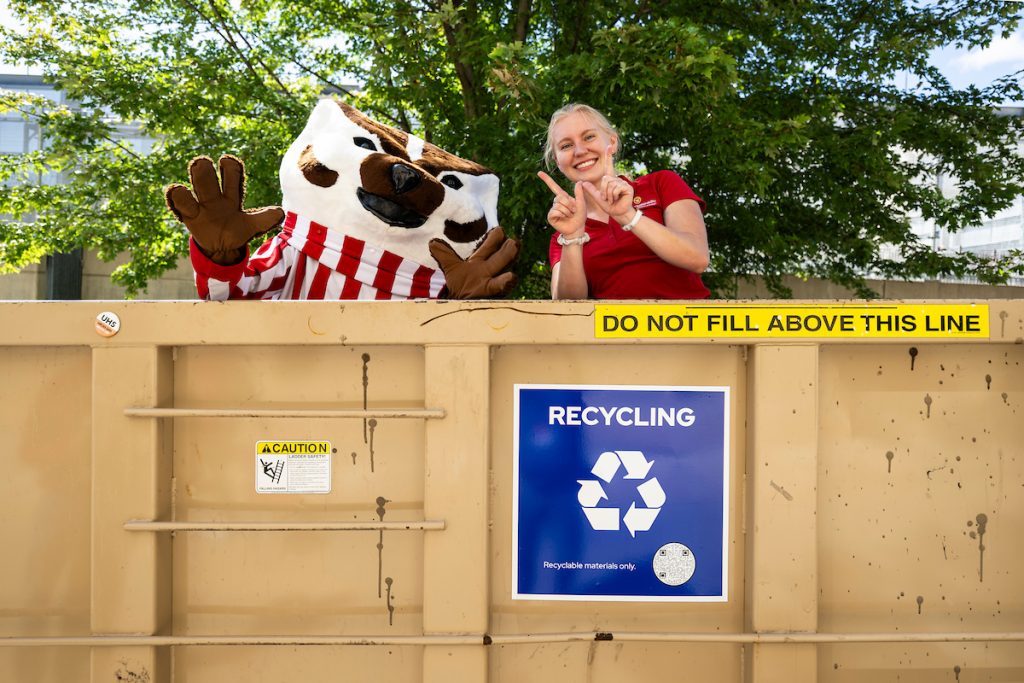
Zero Waste by 2040
By integrating sustainable materials management practices, UW–Madison is taking a transformative approach to help build a circular economy.
How We’re Getting There
UW Zero Waste is a strategic initiative for sustainable materials management at the University of Wisconsin–Madison. Our program looks at the full life cycle of campus waste generation and encourages waste reduction, sustainable procurement, and high diversion rates.
The initiative utilizes cross-functional collaboration, relying on all campus citizens, including students, staff, and faculty, to work toward reducing waste and properly disposing of materials. Our Zero Waste team supports campus through a wide variety of initiatives around food waste, recycling options, and material reuse. Our key campus partners include Waste and Recycling and Housing and Dining, both of whom are committed to helping reduce and sustainably manage campus waste.
Making zero waste possible
Explore the programs, resources, and opportunities helping UW–Madison use less, reuse more, and prevent waste across campus.
Zero Waste refers to responsible production, consumption, reuse, and recovery of products, packaging, and materials. In the context of UW–Madison, this means that we must:
- Reduce our Municipal Solid Waste (MSW) to less than 100 lbs per weighted campus user.
- Divert 90% of Municipal Solid Waste from the landfill and/or incinerator.
- Limit MSW recycling contamination rates to <5% for mixed recyclables and <1% for source-separated recyclables.
- Generate <5lbs/ft2 of construction and demolition waste during new construction and major renovations, and <10lbs/ft2 during minor renovations.
- Divert 90% of non-hazardous construction and demolition waste away from the landfill and/or incinerator.