Sustainability Symposium Highlights Entrepreneurship and Innovation
At the fifth annual Sustainability Symposium, more than 300 students, faculty, staff, and partners gathered at the Discovery Building for conversations about sustainability, innovation, and entrepreneurship at UW–Madison.
“What does it take to turn promising ideas into real-world solutions?” asked Andrea Hicks, director of sustainability education and research. Across disciplines and borders, presenters offered answers.
A New Whey Forward
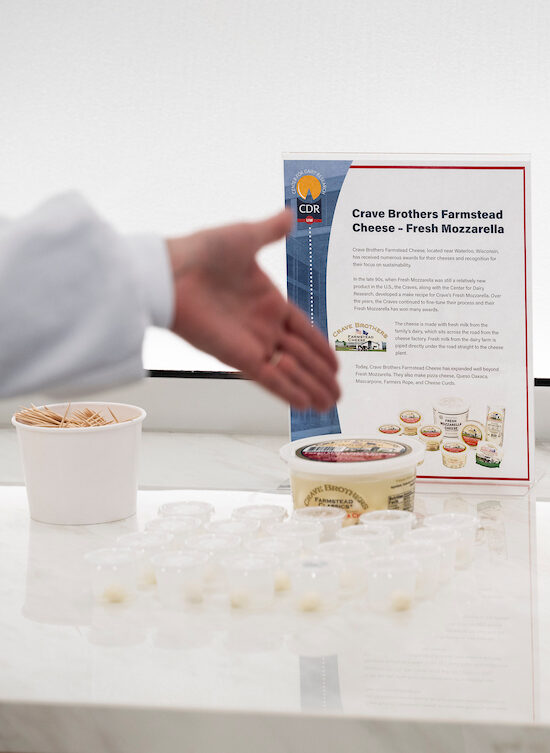
“Imagine buying your favorite sharp cheddar in the future,” says Michael Gay, a development specialist at UW–Madison’s Center for Dairy Research (CDR). “Just like today, it is wrapped in plastic to preserve its quality and provide food safety. The difference will be that plastic in the future will be a polymer that is bio-based, truly biodegradable, and, we hope, made from cheese whey.”
At CDR, Gay and his colleagues are exploring how whey and other dairy coproducts could become everything from natural food ingredients to biofuels. It’s part of what the center calls a dual-sustainability model, built to make Wisconsin’s $53 billion dairy industry greener and more profitable. The model supports both on-farm dairy businesses and an accelerator that helps entrepreneurs and companies take dairy-based innovations to market. Beyond value adds, Gay says, the ultimate goal is “not wasting a drop of milk.”
Cheese from Crave Brothers, one of the on-farm dairy businesses CDR supports through their Dairy Business Innovation Alliance. (Photo by Jeff Miller / UW–Madison)
A Deadly Circular Economy
In Bangladesh, millions of electric three-wheelers, nicknamed “Bangla Teslas,” run on lead-acid batteries. With little foreign competition, local manufacturers make them cheaply, and most die within a year. When they do, they’re melted down and recycled into new ones, typically in open-air smelters that release large amounts of lead into the community.
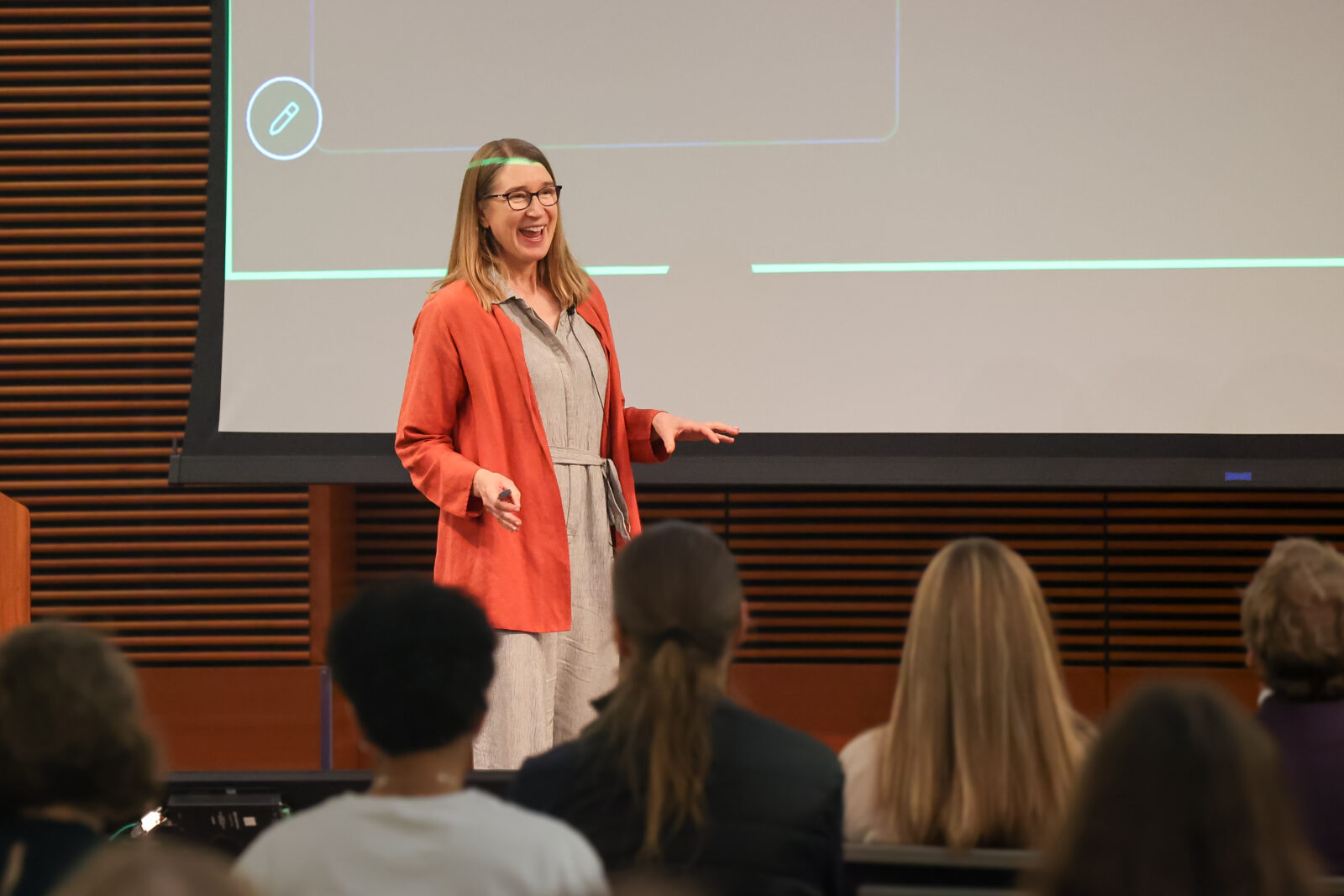
Keynote speaker Erica Plambeck ’94, a professor at the Stanford Graduate School of Business, studies how to break that cycle. Drivers want longer-lasting batteries, but sellers give unreliable information, so most buy the cheapest. Policy could help, but it moves slowly. “You need market-based solutions today while we’re waiting for the government,” says Plambeck.
In field tests, her team offered drivers shopping for new batteries a lead-free lithium battery built to last seven years, but buyers were skeptical. Saying it would last longer didn’t sell it. Neither did offering a warranty on its own, but adding a three-year loan did—drivers figured lenders wouldn’t give them three years to pay for a battery that dies in one, and the monthly payments made the batteries affordable. “That’s the way to break the market failure, break the lemon market, and get highly durable batteries,” Plambeck says.
Keynote speaker Erica Plambeck skipped the formal introduction: “What you need to know is I’m a Badger and my parents are here.” (Photo by Lauren Graves)
Growing a Smaller Footprint
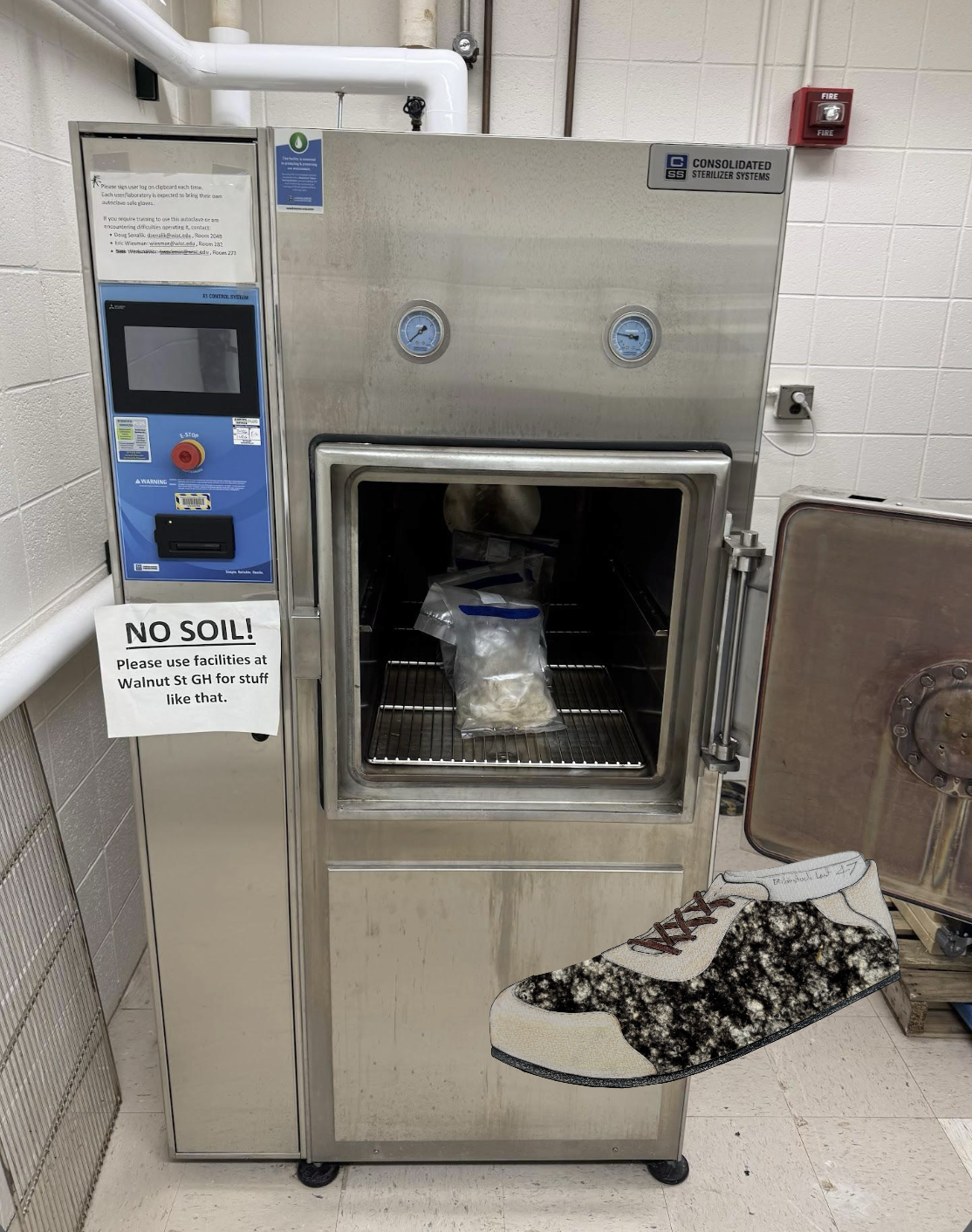
Soren Faulhaber imagines a shoe that is 3D printed, then grown. A textiles and fashion design student, Faulhaber created Underfoot, a proof-of-concept shoe made with wool, hemp, cork, and an insole grown from discarded hemp stalks.
To make the insole, he mixed liquid mycelium with hemp stalks inside a 3D-printed mold. As the fungus grew, it bound the fibers into a spongy material. The result offers a glimpse of how footwear could move away from synthetic, hard-to-recycle materials while creating new uses for agricultural waste.
“It can be fun to think about how different our shopping experience could be if instead of looking online at different shoes we were able to 3D print a certain style and then grow the material ourselves,” Faulhaber says.
The autoclave used to develop Underfoot’s hemp-and-mycelium insole, with a sketch of the shoe. (Images courtesy of Soren Faulhaber)
No Laughing Matter
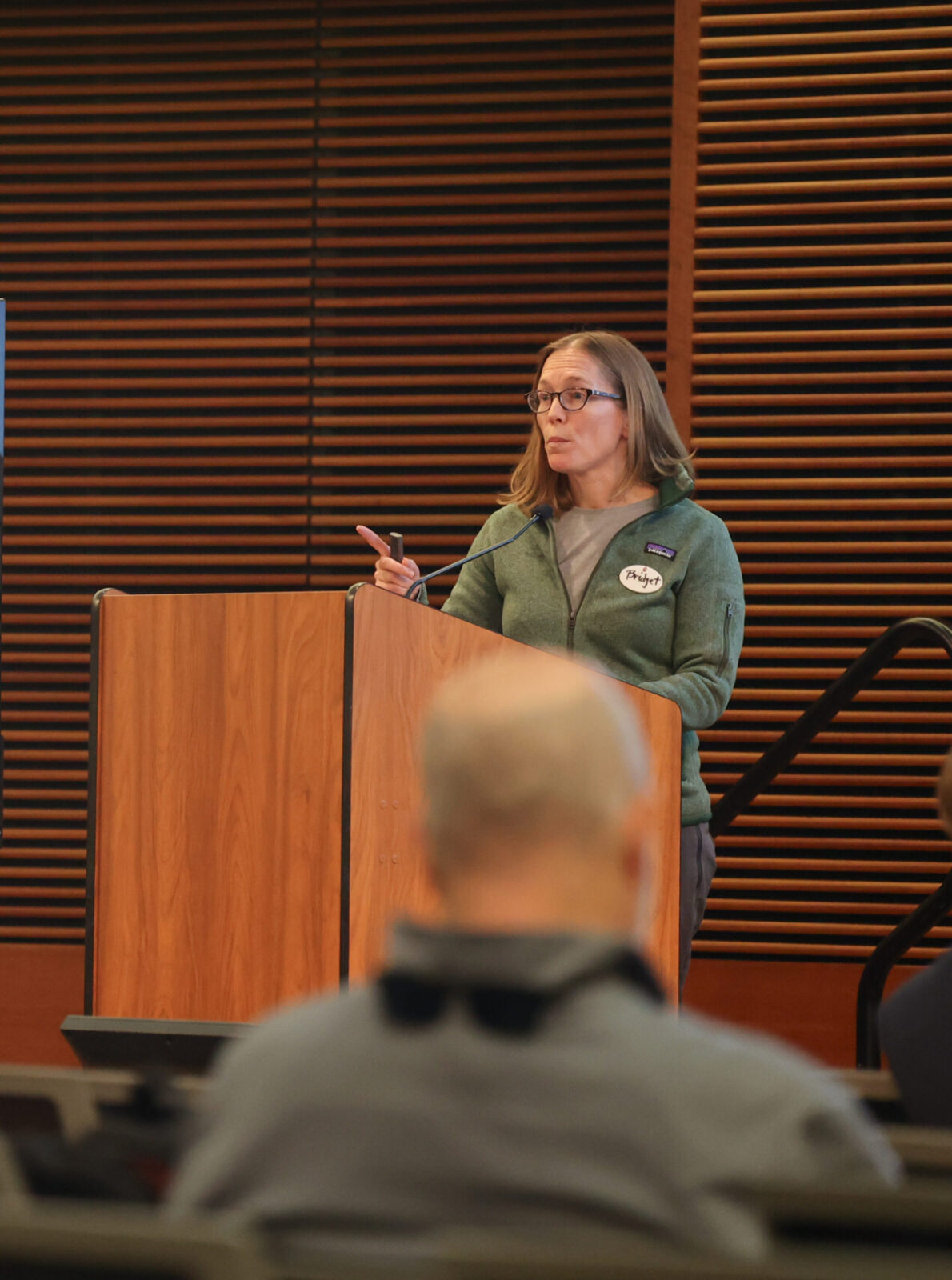
Nitrous oxide, better known as laughing gas, is a common anesthetic and a potent greenhouse gas. After peer hospitals reported massive leaks, UW Health anesthesiologist Bridget Muldowney and her colleagues compared how much nitrous oxide they bought with how much reached patients. “When we quantified our leak at 82.4%, we were not surprised,” Muldowney says. Some hospitals had reported losses as high as 99%.
To fix the leak, UW Health replaced its bulk nitrous oxide system with small tanks mounted to the back of the anesthesia machines. Just as importantly, they changed how clinicians used the gas: educating providers, keeping the tanks closed by default so providers have to open one to use it, and sending each provider a monthly sustainability report.
Colleagues embraced the change for its environmental benefit, Muldowney says. “What I didn’t predict was the magnitude of our reduction in nitrous oxide use.” At East Madison Hospital, use dropped 95% from 2023 to 2026. “I’m as proud of this change as I am of the remedied leak emissions.”
Bridget Muldowney presents a flash talk at the fifth annual Sustainability Symposium. (Photo by Lauren Graves)
An Idea Machine
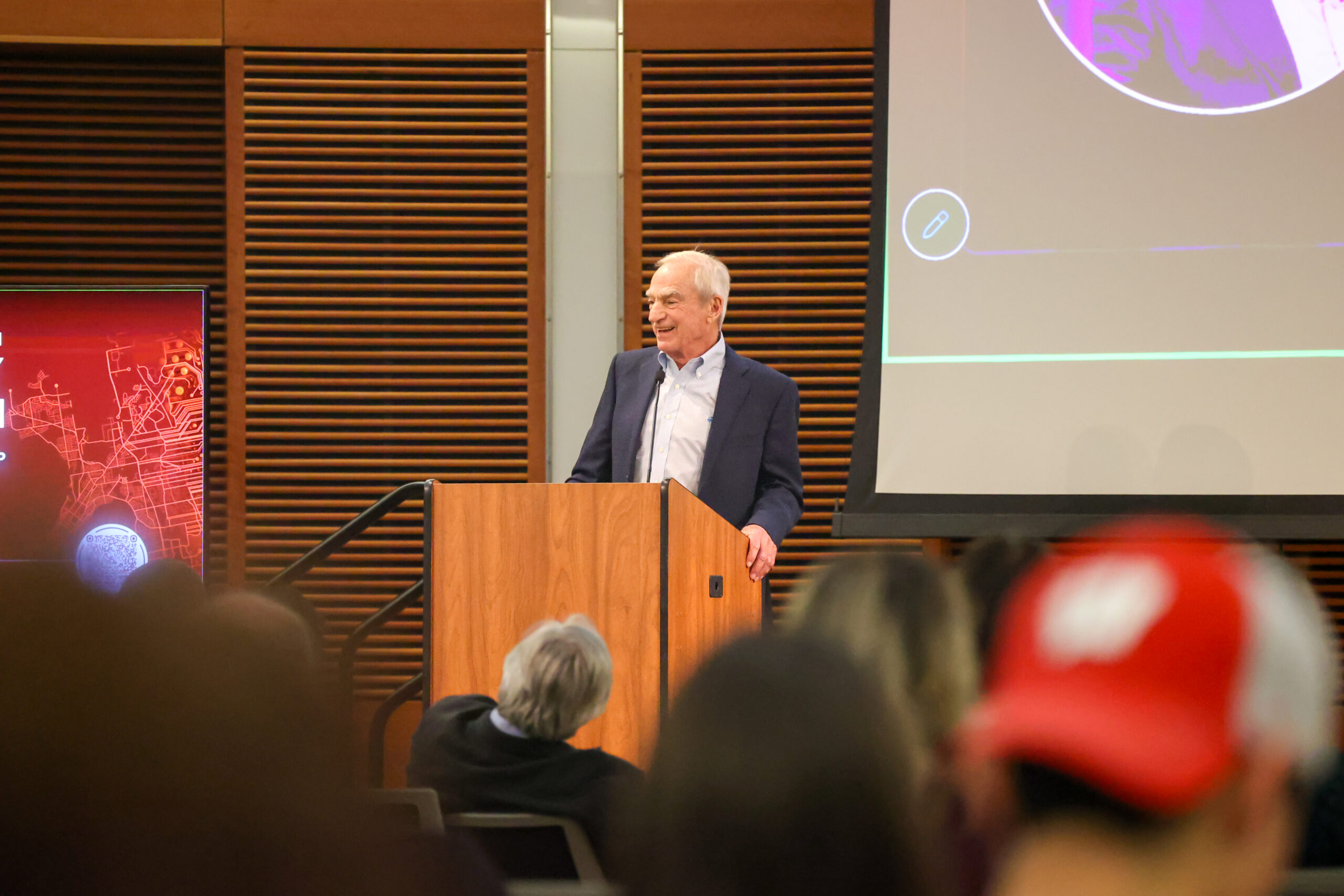
The Symposium also marked a new chapter for UW–Madison’s Green Fund. The program has supported student-led campus sustainability projects since 2017, from solar-powered bus shelters to lower-energy ice cream. At the event, the university celebrated alumnus Jim Weinert ’67, MBA ’69, whose $660,000 gift is helping the fund take on larger, more ambitious projects.
“Jim’s gift inspired us to invite businesses to pitch ideas that students could bring to life on campus,” says Green Fund Manager Ian Aley.
The expansion connects startups and businesses with students and the university’s growing entrepreneurship network, including the Wisconsin School of Business and the Wisconsin Entrepreneurship Hub. Together, they’ll test emerging technologies to advance UW’s net-zero and zero-waste goals, giving students hands-on experience along the way.
“Students are tirelessly inventive and deeply dedicated to solving sustainability problems. That makes the Green Fund, and its newly expanded entrepreneurial efforts, into an idea machine,” says Paul Robbins, dean of the Nelson Institute for Environmental Studies. “It opens the lid on a giant box of fresh innovations. Game-changing.”
Jim Weinert addresses the crowd at the fifth annual Sustainability Symposium. (Photo by Lauren Graves)