Interactive Story Map Showcases Food Scraps Collection and Composting at UW–Madison
Are you curious about food waste and composting on campus? Maybe you’ve noticed compost collection bins are in some locations around UW, but not everywhere.
The University of Wisconsin–Madison has been working on securing sustainable solutions to campus food scraps and food waste since 2009. From an initial pilot project to exploring anaerobic digestion and continually testing new strategies, the university aims to manage organic waste as sustainably as possible.
A Vision of Zero Waste
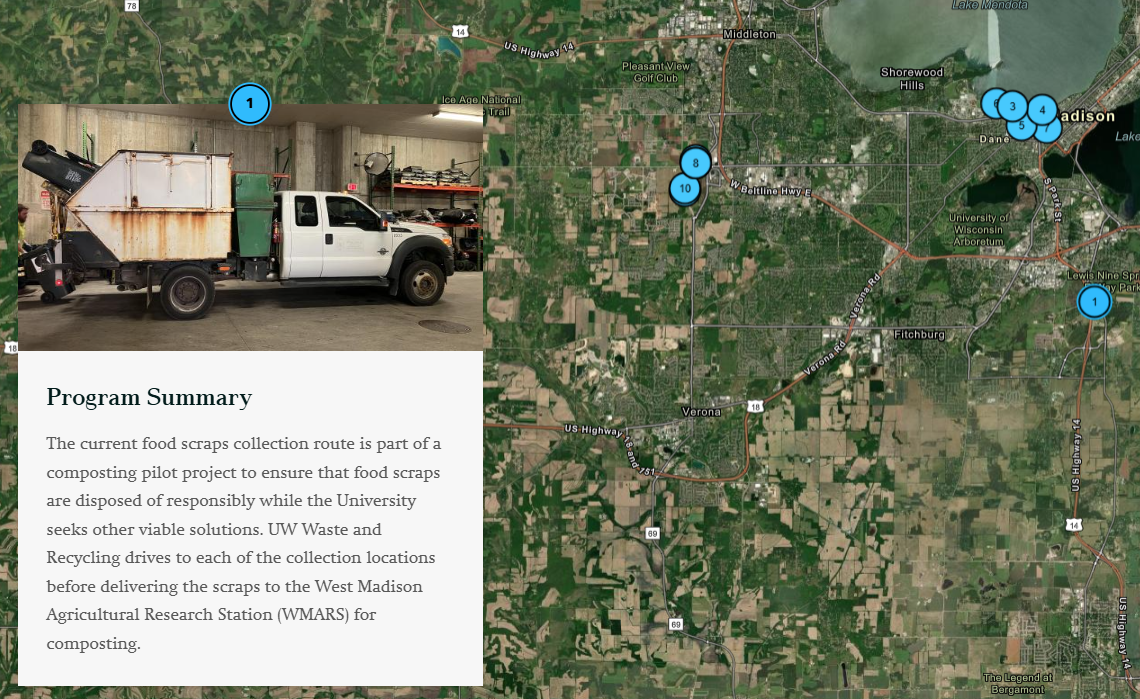
Following a change in material acceptance by UW’s past vendor, the university’s current compost pilot project involves internal collection, hauling, and disposal, with Physical Plant servicing five locations across campus (Memorial Union, Union South, Four Lakes, Gordon’s, and Carson Markets). The majority of scraps collected are from back-of-house areas, coming from the kitchen and preparation areas; however, some plate waste is also collected. Food scraps are then brought to the West Madison Agricultural Research Station (WMARS) for windrow composting, involving long rows of material churned by large machinery. One continuous problem facing composting at UW is contamination—the presence of unacceptable materials in the compost stream, such as plastic and other trash. To expand collection to more areas, including front-of-house and plate waste, the campus community would need to work together to keep the stream clean. Zero Waste is no longer a buzzword on college campuses; it’s a core principle driving innovative projects, research, and operations. Carolyn Shumaker, a former Zero Waste Project Assistant, highlights the intersection of technology, people, sustainability, and storytelling through an engaging ArcGIS Story Map. This interactive map showcases the university’s internal food scrap collection program, managed by its dedicated hauling team, as part of a broader commitment to zero waste.Why an ArcGIS Story Map?
Carolyn’s project began as a way to illustrate the unseen work behind campus sustainability efforts. The university’s food scrap collection program, launched in 2022, aims to divert organic waste from landfills, reducing methane emissions while creating a valuable resource for composting. With the Physical Plant – Waste & Recycling team transporting food scraps from five locations, the program plays a crucial role in progressing towards achieving UW-Madison’s zero waste goal. An ArcGIS Story Map combines maps, narrative text, images, and multimedia content, creating a dynamic, interactive experience. For Carolyn, this platform was ideal for visualizing the collection routes, showcasing the impact of the program, and engaging the broader campus community. “The Office of Sustainability receives a tremendous amount of interest in expanding the university’s food scrap collection. I wanted to create something more than just a static presentation,” Carolyn explained. “The Story Map allows users to see the scale of our efforts, the logistics behind them, and the environmental benefits—all in an interactive format.”
Mapping the Journey
The Story Map is divided into several sections, each highlighting a different aspect of the food scrap collection process:- Collection Points: Users can explore a map of campus dining locations participating in the program, with pop-ups detailing the amount of food waste collected at each site.
- Route Logistics: A route map shows how the internal hauling team efficiently transports food scraps to the composting facility, minimizing fuel consumption and maximizing impact.
- Environmental Impact: This section visualizes data on waste diversion, including metrics like the amount of food waste diverted annually and the corresponding reduction in greenhouse gas emissions.