Carol Barford believes collaboration translates research into action
This article, by Derek Nelson, is part of a series highlighting members of the Office of Sustainability’s Experts Database. In a collaboration with instructor Hannah Monroe’s course, LSC 561: Writing Science for the Public, students interviewed campus sustainability experts and produced short feature stories.
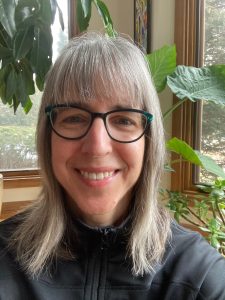
Dr. Carol Barford, director of the Center for Sustainability and the Global Environment (SAGE) at UW–Madison, is facilitating efforts to study the interplay of environmental systems, natural resources, and human activity, while informing technology and policy solutions. As director, Barford is more than a researcher—she’s a connector, bringing together scientists, educators, and policymakers to address challenges that span ecosystems, economies, and communities. Under her leadership since 2011, SAGE has partnered with more than 50 organizations worldwide. From energy use in agriculture to sustainability education, she ensures that good ideas have the resources to thrive.
SAGE’s mission is rooted in conducting policy-relevant environmental science and ensuring it reaches those who need it most. In a world where research often remains siloed—scientific findings disconnected from those making decisions on the ground—Barford plays a critical role in bridging that divide. What began as a hub for quantitative research has evolved under her leadership into a center that actively collaborates with farmers, policymakers, educators, and conservationists. This emphasis on partnership ensures the science is not only rigorous, but also relevant, usable, and responsive to the complex realities of sustainability work. “The goal is to represent the system truthfully and tractably,” Barford said. “We work with many partners to ensure our research is applied in meaningful ways.”
 One of Barford’s recent projects, led by the School of Education, builds on a prior initiative called iPLAN—a learning tool designed to help both children and decision-makers understand the trade-offs of land use decisions.
“I worked on the first iPLAN, focusing on the physical background systems, such as land use outcomes, carbon outcomes, and influences on temperature and wildlife,” Barford said. “Now, we’re developing another version focused on climate change, specifically on temperatures at the end of the century and land use actions that could influence those outcomes.”
This new iteration of iPLAN helps users navigate the relative magnitudes, time scales, and impacts on different communities, especially their own. “When you play the game, you can choose your study area anywhere in the US,” Barford said. “It’s online and being used in classrooms, as well as informal settings like museums and field sites. The education component and evaluating the learning are aspects that are totally new to me, and it’s really interesting.”
Barford simplifies complex sustainability concepts with a relatable analogy: the bathtub model. “There’s a stock in the bathtub, with a flow coming in, and a flow coming out,” she explained. “If the flow in is greater than the flow out, you don’t have a sustainable system.”
Barford finds this analogy especially useful when teaching Environmental Studies 417, where it helps students visualize the delicate balance required to maintain environmental sustainability. The course is held alongside the Weston Roundtable series, a public interactive lecture series that explores sustainability science, engineering, and policy.
During a recent Weston Roundtable, Barford hosted journalist Jeremy Hance and addressed the growing issue of climate anxiety, a topic that resonates deeply with her students. “I think that a lot of students have climate anxiety. I mean, so many of us do,” she said. “Our tendency is to extrapolate out a future that looks pretty horrible. And I think it’s important, especially for younger people, to realize that we don’t know exactly what’s going to happen, and the surprises might be good. I think it’s so important for students to see this and discuss it.”
Reflecting on her time at SAGE, Barford finds motivation in the collaborative nature of her work. “I feel like I’ve met so many people on campus and learned what they do,” she said. “I get a lot of satisfaction being the director of SAGE because the investigators here are doing such great work and really leading in their fields. With so many of them around, there are likewise many things for me to be involved with.” Barford emphasized the importance of the Wisconsin idea—a philosophy that education should influence people’s lives beyond the classroom—not just as a guiding principle of the university, but as a driving force behind her work. “People really embody that here at SAGE,” she said.
One of Barford’s recent projects, led by the School of Education, builds on a prior initiative called iPLAN—a learning tool designed to help both children and decision-makers understand the trade-offs of land use decisions.
“I worked on the first iPLAN, focusing on the physical background systems, such as land use outcomes, carbon outcomes, and influences on temperature and wildlife,” Barford said. “Now, we’re developing another version focused on climate change, specifically on temperatures at the end of the century and land use actions that could influence those outcomes.”
This new iteration of iPLAN helps users navigate the relative magnitudes, time scales, and impacts on different communities, especially their own. “When you play the game, you can choose your study area anywhere in the US,” Barford said. “It’s online and being used in classrooms, as well as informal settings like museums and field sites. The education component and evaluating the learning are aspects that are totally new to me, and it’s really interesting.”
Barford simplifies complex sustainability concepts with a relatable analogy: the bathtub model. “There’s a stock in the bathtub, with a flow coming in, and a flow coming out,” she explained. “If the flow in is greater than the flow out, you don’t have a sustainable system.”
Barford finds this analogy especially useful when teaching Environmental Studies 417, where it helps students visualize the delicate balance required to maintain environmental sustainability. The course is held alongside the Weston Roundtable series, a public interactive lecture series that explores sustainability science, engineering, and policy.
During a recent Weston Roundtable, Barford hosted journalist Jeremy Hance and addressed the growing issue of climate anxiety, a topic that resonates deeply with her students. “I think that a lot of students have climate anxiety. I mean, so many of us do,” she said. “Our tendency is to extrapolate out a future that looks pretty horrible. And I think it’s important, especially for younger people, to realize that we don’t know exactly what’s going to happen, and the surprises might be good. I think it’s so important for students to see this and discuss it.”
Reflecting on her time at SAGE, Barford finds motivation in the collaborative nature of her work. “I feel like I’ve met so many people on campus and learned what they do,” she said. “I get a lot of satisfaction being the director of SAGE because the investigators here are doing such great work and really leading in their fields. With so many of them around, there are likewise many things for me to be involved with.” Barford emphasized the importance of the Wisconsin idea—a philosophy that education should influence people’s lives beyond the classroom—not just as a guiding principle of the university, but as a driving force behind her work. “People really embody that here at SAGE,” she said.
One of Barford’s recent projects, led by the School of Education, builds on a prior initiative called iPLAN—a learning tool designed to help both children and decision-makers understand the trade-offs of land use decisions.
“I worked on the first iPLAN, focusing on the physical background systems, such as land use outcomes, carbon outcomes, and influences on temperature and wildlife,” Barford said. “Now, we’re developing another version focused on climate change, specifically on temperatures at the end of the century and land use actions that could influence those outcomes.”
This new iteration of iPLAN helps users navigate the relative magnitudes, time scales, and impacts on different communities, especially their own. “When you play the game, you can choose your study area anywhere in the US,” Barford said. “It’s online and being used in classrooms, as well as informal settings like museums and field sites. The education component and evaluating the learning are aspects that are totally new to me, and it’s really interesting.”
Barford simplifies complex sustainability concepts with a relatable analogy: the bathtub model. “There’s a stock in the bathtub, with a flow coming in, and a flow coming out,” she explained. “If the flow in is greater than the flow out, you don’t have a sustainable system.”
Barford finds this analogy especially useful when teaching Environmental Studies 417, where it helps students visualize the delicate balance required to maintain environmental sustainability. The course is held alongside the Weston Roundtable series, a public interactive lecture series that explores sustainability science, engineering, and policy.
During a recent Weston Roundtable, Barford hosted journalist Jeremy Hance and addressed the growing issue of climate anxiety, a topic that resonates deeply with her students. “I think that a lot of students have climate anxiety. I mean, so many of us do,” she said. “Our tendency is to extrapolate out a future that looks pretty horrible. And I think it’s important, especially for younger people, to realize that we don’t know exactly what’s going to happen, and the surprises might be good. I think it’s so important for students to see this and discuss it.”
Reflecting on her time at SAGE, Barford finds motivation in the collaborative nature of her work. “I feel like I’ve met so many people on campus and learned what they do,” she said. “I get a lot of satisfaction being the director of SAGE because the investigators here are doing such great work and really leading in their fields. With so many of them around, there are likewise many things for me to be involved with.” Barford emphasized the importance of the Wisconsin idea—a philosophy that education should influence people’s lives beyond the classroom—not just as a guiding principle of the university, but as a driving force behind her work. “People really embody that here at SAGE,” she said.