Can health opportunities arise from climate change? Jonathan Patz thinks so
This article, by Seth Greengo, is part of a series highlighting members of the Office of Sustainability’s Experts Database. In a collaboration with instructor Hannah Monroe’s course, LSC 561: Writing Science for the Public, students interviewed campus sustainability experts and produced short feature stories.
Much of the discourse surrounding sustainability research revolves around the impacts that humans have on the natural environment. In fact, a quick look at the top Google Image search results for the word “sustainability” reveals an abundance of images of plants and the planet Earth. However, the relationship between people and their environment goes both ways. Some of these environmental impacts on people are often mentioned in the news – more frequent extreme weather events, rising sea levels, etc.
But there are some less obvious ways that climate change can affect human health. This overlap between climate change and public health is something that Dr. Jonathan Patz hopes to bring to the forefront of sustainability discussions.
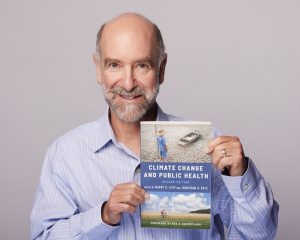 After earning degrees in medicine and public health, Dr. Patz now leads the Climate Solutions for Health Lab at the University of Wisconsin – Madison, where he and his team investigate health co-benefits of climate solutions – the ways that implementing policies to prevent climate change can also improve human wellbeing. The scope of his research interests is broad, ranging from estimating the lives saved by completely switching to clean energy sources to exploring the many ways that walking, biking, or taking public transportation can improve physical health.
Regardless of the topic of a given study, one overarching goal permeates Dr. Patz’ work: to reframe the discussion about climate change by focusing on the ways that living sustainably can also improve human health.
“You know, in addition to more obvious threats on polar bears or crop losses, less visible are climate’s insidious effects on diseases,” said Dr. Patz. “So I’m looking at this intersection of climate change as it impacts our health.”
Early in Dr. Patz’s career, his research focused on the negative impacts of climate change on human health. For example, he and a team of researchers previously found that human activity in the Amazon correlated with a greater prevalence of malaria-transmitting mosquitoes.
But in recent years, Dr. Patz shifted his priority from finding the ways that climate change can adversely impact people’s lives, to demonstrating how sustainable living can simultaneously improve human health and the planet. He believes that across our current landscape of widely polarized attitudes on environmental sustainability, concern about human health offers common ground that can help bridge the divide.
“I think it’s really important to provide a positive message,” he said. “If people know that their climate actions might double to promote human health, incentives can grow as we strive for sustainability.”
What does finding positive impacts of sustainable policies look like? Dr. Patz explained that much of the work is done with computer modeling – using mathematics and computers to predict how a certain outcome changes under different conditions. In the case of modeling health co-benefits of climate solutions, as his group did in a recent study, you could adjust what percentage of the population rides bicycles or walks to work instead of driving and see how illnesses and premature deaths are affected. Dr. Patz’ group develops some of their own models, while others, such as air pollution models, are available from organizations like the Environmental Protection Agency.
While rooted in computer work, these models have real world effects. Dr. Patz realizes that it’s hard to tie a direct correlation between his studies and policy changes, but noted his research has been used by the WHO and some health departments to assess the impact that climate change has on human health. He’s hoping his more recent research on the dual impact of sustainable policies also makes its way into the world of public policy.
“I think this area of co-benefits [of climate solutions] needs to be expanded in order to show the public and decision makers why it’s a great idea to decarbonize,” said Dr. Patz.
To put it succinctly, Dr. Patz’ research tells us that the planet is not the only thing that stands to benefit from climate-positive behavioral changes – we do, too.
“We need to protect natural resources and biodiversity,” he said. “And for sure, we need a healthy planet to maintain ourselves as a healthy species.”
After earning degrees in medicine and public health, Dr. Patz now leads the Climate Solutions for Health Lab at the University of Wisconsin – Madison, where he and his team investigate health co-benefits of climate solutions – the ways that implementing policies to prevent climate change can also improve human wellbeing. The scope of his research interests is broad, ranging from estimating the lives saved by completely switching to clean energy sources to exploring the many ways that walking, biking, or taking public transportation can improve physical health.
Regardless of the topic of a given study, one overarching goal permeates Dr. Patz’ work: to reframe the discussion about climate change by focusing on the ways that living sustainably can also improve human health.
“You know, in addition to more obvious threats on polar bears or crop losses, less visible are climate’s insidious effects on diseases,” said Dr. Patz. “So I’m looking at this intersection of climate change as it impacts our health.”
Early in Dr. Patz’s career, his research focused on the negative impacts of climate change on human health. For example, he and a team of researchers previously found that human activity in the Amazon correlated with a greater prevalence of malaria-transmitting mosquitoes.
But in recent years, Dr. Patz shifted his priority from finding the ways that climate change can adversely impact people’s lives, to demonstrating how sustainable living can simultaneously improve human health and the planet. He believes that across our current landscape of widely polarized attitudes on environmental sustainability, concern about human health offers common ground that can help bridge the divide.
“I think it’s really important to provide a positive message,” he said. “If people know that their climate actions might double to promote human health, incentives can grow as we strive for sustainability.”
What does finding positive impacts of sustainable policies look like? Dr. Patz explained that much of the work is done with computer modeling – using mathematics and computers to predict how a certain outcome changes under different conditions. In the case of modeling health co-benefits of climate solutions, as his group did in a recent study, you could adjust what percentage of the population rides bicycles or walks to work instead of driving and see how illnesses and premature deaths are affected. Dr. Patz’ group develops some of their own models, while others, such as air pollution models, are available from organizations like the Environmental Protection Agency.
While rooted in computer work, these models have real world effects. Dr. Patz realizes that it’s hard to tie a direct correlation between his studies and policy changes, but noted his research has been used by the WHO and some health departments to assess the impact that climate change has on human health. He’s hoping his more recent research on the dual impact of sustainable policies also makes its way into the world of public policy.
“I think this area of co-benefits [of climate solutions] needs to be expanded in order to show the public and decision makers why it’s a great idea to decarbonize,” said Dr. Patz.
To put it succinctly, Dr. Patz’ research tells us that the planet is not the only thing that stands to benefit from climate-positive behavioral changes – we do, too.
“We need to protect natural resources and biodiversity,” he said. “And for sure, we need a healthy planet to maintain ourselves as a healthy species.”
After earning degrees in medicine and public health, Dr. Patz now leads the Climate Solutions for Health Lab at the University of Wisconsin – Madison, where he and his team investigate health co-benefits of climate solutions – the ways that implementing policies to prevent climate change can also improve human wellbeing. The scope of his research interests is broad, ranging from estimating the lives saved by completely switching to clean energy sources to exploring the many ways that walking, biking, or taking public transportation can improve physical health.
Regardless of the topic of a given study, one overarching goal permeates Dr. Patz’ work: to reframe the discussion about climate change by focusing on the ways that living sustainably can also improve human health.
“You know, in addition to more obvious threats on polar bears or crop losses, less visible are climate’s insidious effects on diseases,” said Dr. Patz. “So I’m looking at this intersection of climate change as it impacts our health.”
Early in Dr. Patz’s career, his research focused on the negative impacts of climate change on human health. For example, he and a team of researchers previously found that human activity in the Amazon correlated with a greater prevalence of malaria-transmitting mosquitoes.
But in recent years, Dr. Patz shifted his priority from finding the ways that climate change can adversely impact people’s lives, to demonstrating how sustainable living can simultaneously improve human health and the planet. He believes that across our current landscape of widely polarized attitudes on environmental sustainability, concern about human health offers common ground that can help bridge the divide.
“I think it’s really important to provide a positive message,” he said. “If people know that their climate actions might double to promote human health, incentives can grow as we strive for sustainability.”
What does finding positive impacts of sustainable policies look like? Dr. Patz explained that much of the work is done with computer modeling – using mathematics and computers to predict how a certain outcome changes under different conditions. In the case of modeling health co-benefits of climate solutions, as his group did in a recent study, you could adjust what percentage of the population rides bicycles or walks to work instead of driving and see how illnesses and premature deaths are affected. Dr. Patz’ group develops some of their own models, while others, such as air pollution models, are available from organizations like the Environmental Protection Agency.
While rooted in computer work, these models have real world effects. Dr. Patz realizes that it’s hard to tie a direct correlation between his studies and policy changes, but noted his research has been used by the WHO and some health departments to assess the impact that climate change has on human health. He’s hoping his more recent research on the dual impact of sustainable policies also makes its way into the world of public policy.
“I think this area of co-benefits [of climate solutions] needs to be expanded in order to show the public and decision makers why it’s a great idea to decarbonize,” said Dr. Patz.
To put it succinctly, Dr. Patz’ research tells us that the planet is not the only thing that stands to benefit from climate-positive behavioral changes – we do, too.
“We need to protect natural resources and biodiversity,” he said. “And for sure, we need a healthy planet to maintain ourselves as a healthy species.”