Forest restoration one soundscape at a time, with Zuzana Burivalova
This article, by Doran Goldman, is part of a series highlighting members of the Office of Sustainability’s Experts Database. In a collaboration with instructor Hannah Monroe’s course, LSC 561: Writing Science for the Public, students interviewed campus sustainability experts and produced short feature stories.
Tropical forests contain half of the world’s terrestrial species, but they are losing this biodiversity at an unprecedented rate—and much of it without our even noticing. As a student, UW–Madison professor Zuzana Burivalova was fascinated by this extreme diversity and drawn to conservation biology in hopes of helping to protect it. Today, members of her Sound Forest laboratory regularly travel to forests across five continents to collect long-term audio and video recordings that provide valuable biodiversity measurements—and comprehensive insights into forest changes over time—for researchers, policymakers, and local communities alike.
 Though species losses are occurring in forests around the world, accurately tracking the populations of animal species is often challenging, with no simple correlation to easier-to-obtain measures like tree cover or deforestation. For instance, Burivalova explained, while rapid clearing of trees for agriculture may immediately eliminate native animal species from that area, subtler disturbances like selective logging may take years to show their impact or may reduce species numbers without fully driving them to extinction.
Despite these challenges, accurately quantifying animal biodiversity is crucial for obtaining a comprehensive picture of these diverse habitats and their restoration needs, especially in a world with rapidly changing climate and sustainability needs. Burivalova’s Sound Forest laboratory works to provide these measures at high resolution, using audio and video recordings to capture even rare or elusive species which may be partially, but not fully driven to extinction by human activity.
For Burivalova, the most surprising aspect of the work is the sheer amount that we can learn from listening to the forest.
“There are species that even the most local experts can’t know […] from the sounds,” she said. “So I think it’s just surprising how much information there is.”
This detailed information can be used in many ways. For instance, the lab has used recordings to track total acoustic volume in forest soundscapes over the course of each day, identifying changes that consistently occur across sites as forests are degraded for logging or agriculture.
For Burivalova, the most important use of the data is to better understand the impacts of reforestation efforts throughout the globe.
“Big companies are investing into natural climate solutions, and they are trying to maximize how much carbon is stored in nature,” she said. “But almost none of these efforts measure any kind of biodiversity outcomes. And sometimes it’s possible that for the sake of protecting carbon trying to save the climate, you may be sacrificing biodiversity.”
By providing these biodiversity measures, the Sound Forest laboratory helps to hold organizations accountable for the full range of impacts of restoration efforts and guide future restoration project designs.
Collecting data on forest biodiversity can also have important implications for local communities. In Gabon, sound recordings from an ancestral forest of the local Massaha community provided them with the evidence needed to withdraw the forest, through an established bureaucratic process, from a logging concession owned by a foreign company. Other times, the laboratory has worked with local scientists to collect data on forests that may already be protected.
Though species losses are occurring in forests around the world, accurately tracking the populations of animal species is often challenging, with no simple correlation to easier-to-obtain measures like tree cover or deforestation. For instance, Burivalova explained, while rapid clearing of trees for agriculture may immediately eliminate native animal species from that area, subtler disturbances like selective logging may take years to show their impact or may reduce species numbers without fully driving them to extinction.
Despite these challenges, accurately quantifying animal biodiversity is crucial for obtaining a comprehensive picture of these diverse habitats and their restoration needs, especially in a world with rapidly changing climate and sustainability needs. Burivalova’s Sound Forest laboratory works to provide these measures at high resolution, using audio and video recordings to capture even rare or elusive species which may be partially, but not fully driven to extinction by human activity.
For Burivalova, the most surprising aspect of the work is the sheer amount that we can learn from listening to the forest.
“There are species that even the most local experts can’t know […] from the sounds,” she said. “So I think it’s just surprising how much information there is.”
This detailed information can be used in many ways. For instance, the lab has used recordings to track total acoustic volume in forest soundscapes over the course of each day, identifying changes that consistently occur across sites as forests are degraded for logging or agriculture.
For Burivalova, the most important use of the data is to better understand the impacts of reforestation efforts throughout the globe.
“Big companies are investing into natural climate solutions, and they are trying to maximize how much carbon is stored in nature,” she said. “But almost none of these efforts measure any kind of biodiversity outcomes. And sometimes it’s possible that for the sake of protecting carbon trying to save the climate, you may be sacrificing biodiversity.”
By providing these biodiversity measures, the Sound Forest laboratory helps to hold organizations accountable for the full range of impacts of restoration efforts and guide future restoration project designs.
Collecting data on forest biodiversity can also have important implications for local communities. In Gabon, sound recordings from an ancestral forest of the local Massaha community provided them with the evidence needed to withdraw the forest, through an established bureaucratic process, from a logging concession owned by a foreign company. Other times, the laboratory has worked with local scientists to collect data on forests that may already be protected.
 Working across these different forest sites can have its challenges. Biodiversity baselines may vary widely across locations, and they require constant updating in the face of unpredictable occurrences like disease outbreaks or droughts. According to Burivalova, a level of logging that was considered sustainable five years ago may no longer be so sustainable now if sound data reveals increasing biodiversity losses with climate change.
And there are more practical difficulties in collecting this data too—often the amount of data collected measures in the tens of terabytes per site per year, and members of the lab need to physically carry these data out of the jungle on heavy hard drives when cell or satellite coverage is not available.
Burivalova and her colleagues take these challenges in stride.
“Ecuador is such a different country to Gabon or Germany,” she said, “but at the end of the day, what’s similar is that the people I work with usually are just in love with their forest, and they just want to make sure it’s protected.”
Working across these different forest sites can have its challenges. Biodiversity baselines may vary widely across locations, and they require constant updating in the face of unpredictable occurrences like disease outbreaks or droughts. According to Burivalova, a level of logging that was considered sustainable five years ago may no longer be so sustainable now if sound data reveals increasing biodiversity losses with climate change.
And there are more practical difficulties in collecting this data too—often the amount of data collected measures in the tens of terabytes per site per year, and members of the lab need to physically carry these data out of the jungle on heavy hard drives when cell or satellite coverage is not available.
Burivalova and her colleagues take these challenges in stride.
“Ecuador is such a different country to Gabon or Germany,” she said, “but at the end of the day, what’s similar is that the people I work with usually are just in love with their forest, and they just want to make sure it’s protected.”
Though species losses are occurring in forests around the world, accurately tracking the populations of animal species is often challenging, with no simple correlation to easier-to-obtain measures like tree cover or deforestation. For instance, Burivalova explained, while rapid clearing of trees for agriculture may immediately eliminate native animal species from that area, subtler disturbances like selective logging may take years to show their impact or may reduce species numbers without fully driving them to extinction.
Despite these challenges, accurately quantifying animal biodiversity is crucial for obtaining a comprehensive picture of these diverse habitats and their restoration needs, especially in a world with rapidly changing climate and sustainability needs. Burivalova’s Sound Forest laboratory works to provide these measures at high resolution, using audio and video recordings to capture even rare or elusive species which may be partially, but not fully driven to extinction by human activity.
For Burivalova, the most surprising aspect of the work is the sheer amount that we can learn from listening to the forest.
“There are species that even the most local experts can’t know […] from the sounds,” she said. “So I think it’s just surprising how much information there is.”
This detailed information can be used in many ways. For instance, the lab has used recordings to track total acoustic volume in forest soundscapes over the course of each day, identifying changes that consistently occur across sites as forests are degraded for logging or agriculture.
For Burivalova, the most important use of the data is to better understand the impacts of reforestation efforts throughout the globe.
“Big companies are investing into natural climate solutions, and they are trying to maximize how much carbon is stored in nature,” she said. “But almost none of these efforts measure any kind of biodiversity outcomes. And sometimes it’s possible that for the sake of protecting carbon trying to save the climate, you may be sacrificing biodiversity.”
By providing these biodiversity measures, the Sound Forest laboratory helps to hold organizations accountable for the full range of impacts of restoration efforts and guide future restoration project designs.
Collecting data on forest biodiversity can also have important implications for local communities. In Gabon, sound recordings from an ancestral forest of the local Massaha community provided them with the evidence needed to withdraw the forest, through an established bureaucratic process, from a logging concession owned by a foreign company. Other times, the laboratory has worked with local scientists to collect data on forests that may already be protected.
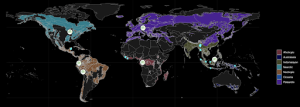
A map of forest sites around the world that the Sound Forest lab studies.