Sustained by Students: The Volunteers Keeping Campus Bat Monitoring Alive
Words by Laleh Ahmad
Photos by Jeff Miller & Kate Scroggins
At 8 pm, the Lakeshore Nature Preserve is already pitch-black. Makeela Magomolla greets me near the entrance, armed with a headlamp and backpack, and we make our way down the path. By now, I’ve already missed sunset, the ideal time to see bats exiting the bat roost— which is hardly a 2-minute walk from the parking lot.
From her backpack — the bat kit — Magomolla pulls out an old iPhone and an attached red device. This unassuming plastic attachment is an acoustic monitoring device, one that picks up the acoustic signals that bats use for echolocation. For most of our conversation, the spectrogram on the iPhone only picks up ambient noise and our speech. About thirty minutes in, however, a sharp comma-shaped line appears.

It’s a little brown bat, Magomolla tells me, as I look at the sky to try and identify it. There are hundreds in the roost, but it’s late in the season, and we only see a few more commas appear on the spectrogram.
Magomolla helps run the UW–Madison Bat Brigade, a collective of students and professionals interested in monitoring bat populations at the Lakeshore Nature Preserve, a 300-acre natural area roughly one-third the size of UW–Madison’s main campus. The Preserve often acts as a living laboratory for students, faculty, and staff interested in its rich biodiversity, and the Bat Brigade, a UW’s Biology Core Curriculum (Biocore collaboration with the Wisconsin Bat Program, is no different.
“The Bat Brigade is central to the Preserve’s mission,” says Brad Herrick, the Lakeshore Nature Preserve Director, “because it combines research, teaching, education, and outreach.” With tools like the echolocation detector and thermal imaging, participants help establish long-term data that contributes to research on population sizes, habitat use, and migration patterns. The Wisconsin Bat Program, an initiative started by the Wisconsin Department of Natural Resources, uses this data in statewide bat monitoring efforts.
“This migration and roosting data doesn’t exist anywhere else,” says Herrick.
Bats are hard to study. They’re nocturnal, fast, and often roost out of sight, and they can cover great distances in a short time. In 2024, researchers saw how far: a female little brown bat from the Picnic Point bat house turned up at a winter hibernation site 176 miles away in Pierce County. White-nose syndrome, a fungal disease of hibernating bats, reached Wisconsin in 2014, and little brown bat numbers fell by roughly 75 percent, according to the DNR.
But some Wisconsin sites are rebounding, and Picnic Point is one. DNR researchers counted about 300 little brown bats at the bat house in 2024, up from a low of 60 in 2017–18 and approaching pre-white-nose levels. Tracking a comeback like that takes people willing to stand in the dark and count. The UW Bat Brigade’s student and community volunteers count bats at dusk and record their calls, and the data feeds the DNR’s Wisconsin Bat Program. That gives biologists the baseline they need to design conservation that works.
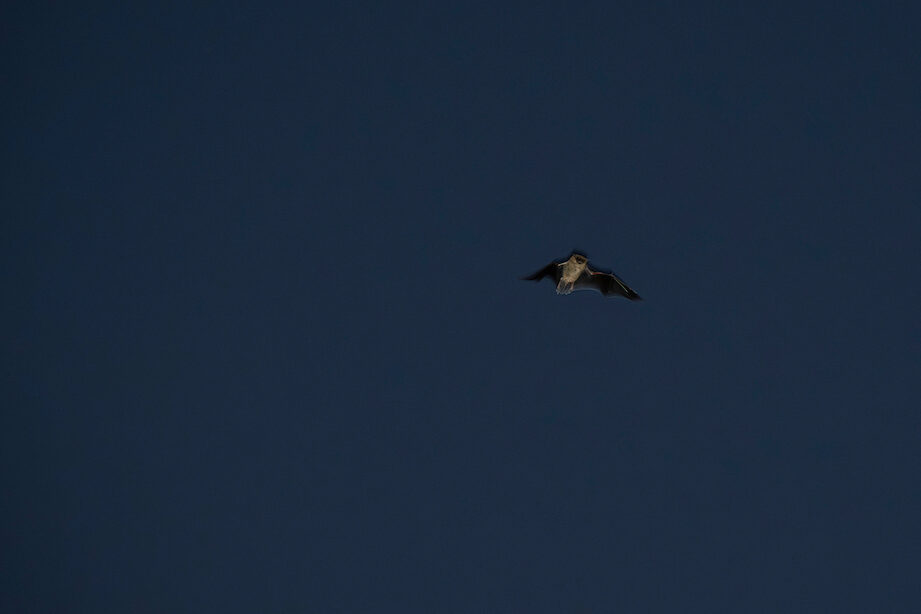
Magomolla emphasizes the importance of community science, explaining that bats often roost on private property. “Community participation gives the program a reach that staff can’t have alone,” she explains.
Her journey, too, is a good example of this. After graduating as an undergraduate from UW–Madison, Magomolla pursued a conservation-education internship at the International Crane Foundation in Rwanda. Bats, originally, were not her focus. But upon returning to the Midwest, she became curious about how taxonomically unique they are. Bats have often been vilified. But where some see fear, Magomolla saw an opportunity for greater understanding.
In Madison, Magomolla began to reach out to people in the bat community. She asked what role she could play, and Seth McGee, a Biocore instructor, welcomed her in. He pointed her to the then-dormant Bat Brigade.
In the last ten years, the Bat Brigade has “waxed and waned,” as Bryn Scriver, the Preserve’s outreach coordinator, phrased it. Started around 2016 by Friends of the Lakeshore Nature Preserve members Kennedy Gilchrist and Levi Wood, it took some time before the group became involved with Biocore and more students began participating. During the pandemic, the Bat Brigade waned.
“Projects like this thrive with student champions,” explains Scriver. And it found one in Magomolla, even though she was only a prospective student at the time. Today, she co-leads the brigade and is a first-year master’s student in the Environment and Resources program at the Nelson Institute for Environmental Studies.
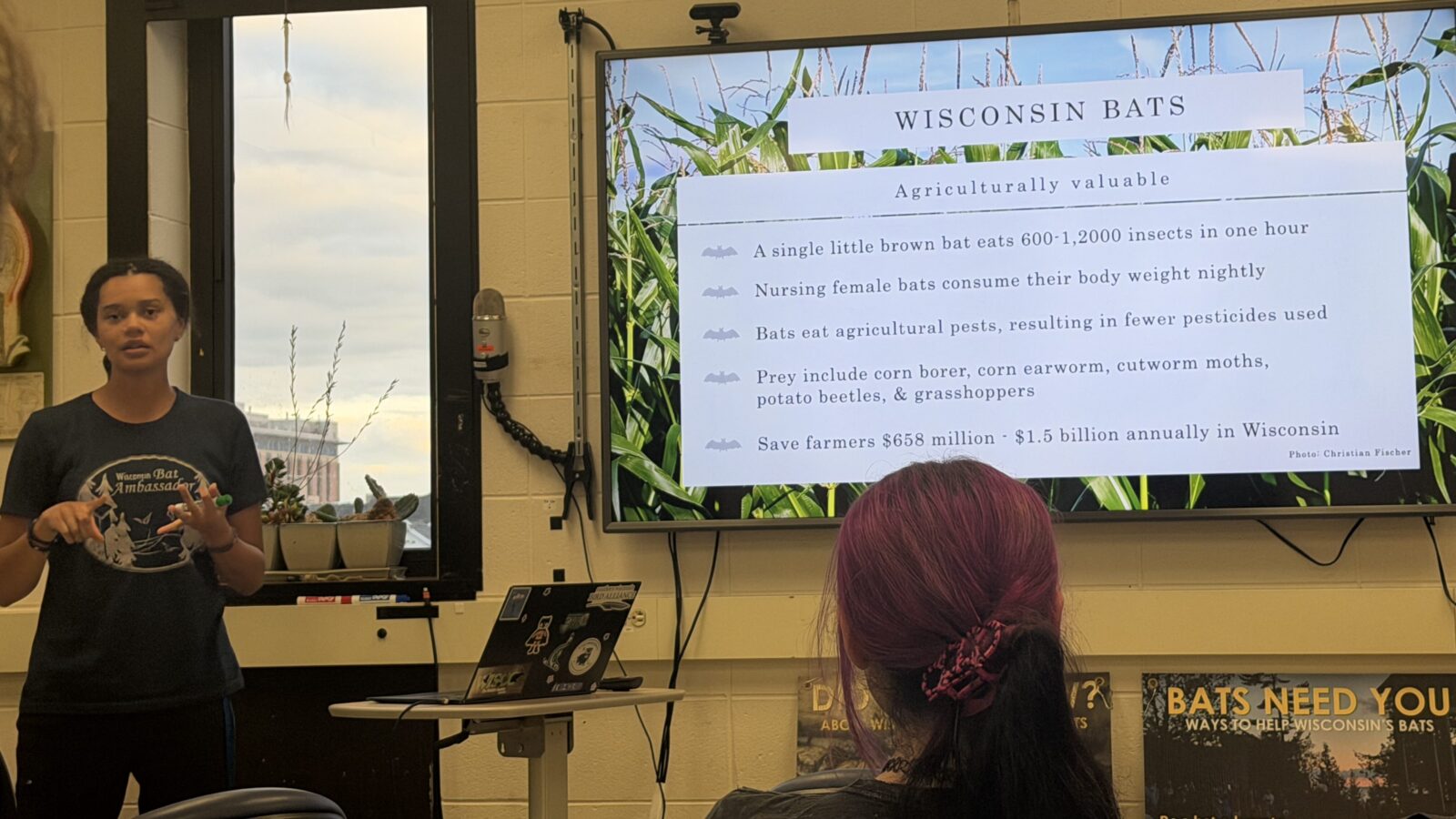
Leading the Bat Brigade is a volunteer position. Magomolla does it because she loves it, and because she knows how special it is. Before she was a graduate student, there weren’t many ways she could contribute — except for the Bat Brigade. This is a common experience. Magomolla recounts the story of a consultant based in Iowa, who drove to Madison for one of the night hikes. “It was the closest event,” Magomolla said, “and the only way to build experience before they could apply to grad school.”
In talking to one community member at a Bat Brigade info session, their motivation for attending the info session comes up. “I came because I’m always trying to find new ways to be a more thoughtful witness to the world. I enjoyed learning how much life is moving through Madison after dark, mostly unnoticed, and how the Bat Brigade turns that curiosity into real conservation work. It makes bats feel less like background scenery and more like neighbors I still have a lot to learn about.”
With Magomolla in the Lakeshore Nature Preserve after dark, I too felt my curiosity spike with each blip on the spectrogram. The Bat Brigade is open to anyone who feels that same curiosity about the wide world of the Preserve after dark.