New BCycle Station Expands Access to UW Arboretum
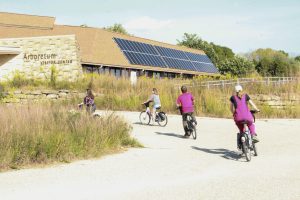
If you were to bike by the Arboretum Visitor Center on Friday, October 3rd, you might have caught UW–Madison students and staff laughing together and ringing their bike bells in celebration as they rode BCycles around the small circle. It was a beautifully sunny fall day for the event, and attendees certainly took advantage. Until recently, if you wanted to ride a BCycle to the Visitor Center like our attendees, you’d have nowhere to dock it as you arrive and no ability to pick up an e-bike in the interior of the natural area. But now, thanks to the work of a number of Arboretum staff and determined students enthusiastic about local sustainability initiatives, the Arboretum Visitor Center can boast its very own BCycle station.
 The station, installed in June, was the result of collaboration between the Arboretum and students working with the UW–Madison Green Fund, which supports student-led environmental initiatives, to make the Arboretum more accessible to students, neighbors, and community members. The event started out with student organizations Climate Leaders for Energy Action Now (CLEAN), Helios, and the Audubon Society UW–Madison, and Office of Sustainability and Arboretum staff tabling to share about recent student initiatives on campus, such as bird-safe glass at Dejope Residence Hall and solar panels at the Arboretum Visitor Center. BCycle and UW–Madison Transportation Services staff shared about the BCycle system and bike resources on campus. Event attendees had the opportunity to ask questions about projects and programming.
The east entrance to the Arboretum sits one mile south of the edge of campus and the Visitor Center is another roughly two and a half miles into the park from there, but for those without cars, it can feel much further. Emily Valentine, CLEAN member, was the co-lead on this project and emphasized the importance of student involvement, explaining that it brings in the “perspective of what it’s like to be a student on campus.” In this case, she noted that “the Arboretum is so beautiful but not accessible to Madison students.”
More sustainable modes of transportation to the Arboretum also come with their own difficulties. Taking the bus to the Arboretum Visitor Center requires a 25-minute walk from the nearest bus stop to the west entrance to the Arboretum or a roughly hour-long walk from the east entrance. The hilly terrain makes biking without an electric assist a challenge for some people. These obstacles mean students sometimes have a hard time attending events, conducting research, or enjoying the over 17 miles of trails offered by the Arboretum. Those with physical disabilities may have even greater barriers, especially as our summers get warmer. And so, as Valentine says, the station was sorely needed for the Arboretum to extend a wider welcome to students and the wider community.
The station, installed in June, was the result of collaboration between the Arboretum and students working with the UW–Madison Green Fund, which supports student-led environmental initiatives, to make the Arboretum more accessible to students, neighbors, and community members. The event started out with student organizations Climate Leaders for Energy Action Now (CLEAN), Helios, and the Audubon Society UW–Madison, and Office of Sustainability and Arboretum staff tabling to share about recent student initiatives on campus, such as bird-safe glass at Dejope Residence Hall and solar panels at the Arboretum Visitor Center. BCycle and UW–Madison Transportation Services staff shared about the BCycle system and bike resources on campus. Event attendees had the opportunity to ask questions about projects and programming.
The east entrance to the Arboretum sits one mile south of the edge of campus and the Visitor Center is another roughly two and a half miles into the park from there, but for those without cars, it can feel much further. Emily Valentine, CLEAN member, was the co-lead on this project and emphasized the importance of student involvement, explaining that it brings in the “perspective of what it’s like to be a student on campus.” In this case, she noted that “the Arboretum is so beautiful but not accessible to Madison students.”
More sustainable modes of transportation to the Arboretum also come with their own difficulties. Taking the bus to the Arboretum Visitor Center requires a 25-minute walk from the nearest bus stop to the west entrance to the Arboretum or a roughly hour-long walk from the east entrance. The hilly terrain makes biking without an electric assist a challenge for some people. These obstacles mean students sometimes have a hard time attending events, conducting research, or enjoying the over 17 miles of trails offered by the Arboretum. Those with physical disabilities may have even greater barriers, especially as our summers get warmer. And so, as Valentine says, the station was sorely needed for the Arboretum to extend a wider welcome to students and the wider community.
 Aware of these accessibility concerns and the climate change implications arising from driving cars, a coalition of people came together to make this project possible. Students from CLEAN took charge of writing the Green Fund proposal for the project.
The process itself was a learning experience, too. Valentine emphasized how even simple projects involve “so many factors” and that working with different stakeholders, like UW–Madison Transportation Services, BCycle and Arboretum staff taught CLEAN members a lot about initiating local efforts to create meaningful change. The Green Fund offers financial support, but just as importantly, Office of Sustainability staff walk with students as they translate their idea into a reality, helping them navigate the approvals process, calculate impacts, and tell the story. This “campus as living lab,” applied learning experience for students helping the UW–Madison achieve the Chancellor’s Sustainability Goals.
In addition to a $20,000 grant from the UW–Madison Green Fund, the project was supported by a $15,000 matching gift from Friends of the Arboretum, and a $4,000 gift from a generous donor. After these funding streams came together, the staff at the Arboretum launched a crowdfunding campaign to close most of the gap to the $50,000 needed for the BCycle station installation costs. The remainder of the funding gap, in addition to ongoing and future operational costs, will be covered by the Arboretum’s budget.
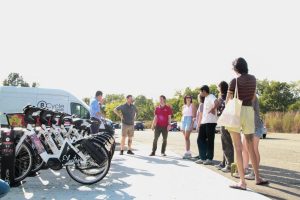
To round out the event and properly celebrate the station, attendees later followed Emily Valentine from CLEAN and Josh Goldman, Associate Director at the Arboretum, out to the BCycle Station. There, Goldman and Valentine said a few words to officially celebrate the opening of the station, before encouraging attendees to take advantage of the beautiful sunny day and test ride the BCycles.
Aware of these accessibility concerns and the climate change implications arising from driving cars, a coalition of people came together to make this project possible. Students from CLEAN took charge of writing the Green Fund proposal for the project.
The process itself was a learning experience, too. Valentine emphasized how even simple projects involve “so many factors” and that working with different stakeholders, like UW–Madison Transportation Services, BCycle and Arboretum staff taught CLEAN members a lot about initiating local efforts to create meaningful change. The Green Fund offers financial support, but just as importantly, Office of Sustainability staff walk with students as they translate their idea into a reality, helping them navigate the approvals process, calculate impacts, and tell the story. This “campus as living lab,” applied learning experience for students helping the UW–Madison achieve the Chancellor’s Sustainability Goals.
In addition to a $20,000 grant from the UW–Madison Green Fund, the project was supported by a $15,000 matching gift from Friends of the Arboretum, and a $4,000 gift from a generous donor. After these funding streams came together, the staff at the Arboretum launched a crowdfunding campaign to close most of the gap to the $50,000 needed for the BCycle station installation costs. The remainder of the funding gap, in addition to ongoing and future operational costs, will be covered by the Arboretum’s budget.
To round out the event and properly celebrate the station, attendees later followed Emily Valentine from CLEAN and Josh Goldman, Associate Director at the Arboretum, out to the BCycle Station. There, Goldman and Valentine said a few words to officially celebrate the opening of the station, before encouraging attendees to take advantage of the beautiful sunny day and test ride the BCycles.
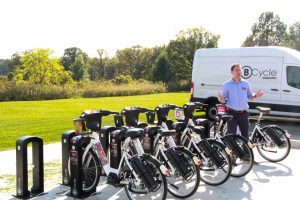 The station itself is more energy and space efficient than older BCycle station models, relying solely on the battery packs attached to the bikes, adding even more green infrastructure at the Arboretum. And although the BCycle station increases physical accessibility, it’s worth noting that using them might pose a financial barrier to some. For UW–Madison employees and students, BCycle offers reduced price memberships. For community members, the Madison Public Library offers a BCycle community pass program for library cardholders.
In Goldman’s remarks, he emphasized that sustainable transportation was essential to allow students, neighbors, and community members to experience the educational opportunities and natural environment that the Arboretum provides and preserves. He also mentioned that it was an important way to improve the connection to campus, and that they were already seeing the fruits of their labor through frequent use of the station. Perhaps, as Steven Espada Dawson, Madison’s own poet laureate and Arboretum enjoyer, said: the station is “the most interesting thing to hit the Arboretum since the invention of trees.”
By: Laleh Ahmad
The station itself is more energy and space efficient than older BCycle station models, relying solely on the battery packs attached to the bikes, adding even more green infrastructure at the Arboretum. And although the BCycle station increases physical accessibility, it’s worth noting that using them might pose a financial barrier to some. For UW–Madison employees and students, BCycle offers reduced price memberships. For community members, the Madison Public Library offers a BCycle community pass program for library cardholders.
In Goldman’s remarks, he emphasized that sustainable transportation was essential to allow students, neighbors, and community members to experience the educational opportunities and natural environment that the Arboretum provides and preserves. He also mentioned that it was an important way to improve the connection to campus, and that they were already seeing the fruits of their labor through frequent use of the station. Perhaps, as Steven Espada Dawson, Madison’s own poet laureate and Arboretum enjoyer, said: the station is “the most interesting thing to hit the Arboretum since the invention of trees.”
By: Laleh Ahmad
Event attendees test riding the new BCycles and ringing their bells to celebrate.
Attendees gathered around the new BCycle station.
Josh Goldman, Associate Director at the Arboretum, addressing attendees.