A Sustainable Alternative to Synthetic Fertilizer with Jean-Michel Ané
This article, by Jack Rodriguez, is part of a series highlighting members of the Office of Sustainability’s Experts Database. In a collaboration with instructor Hannah Monroe’s course, LSC 561: Writing Science for the Public, students interviewed campus sustainability experts and produced short feature stories.
With a rapidly expanding global population, nitrogen has become more important than ever. Essential for crop growth, it’s a key ingredient in the synthetic fertilizers that power modern agriculture. However, despite making up 78% of the air we breathe, converting atmospheric nitrogen to usable forms that can support crops – such as ammonia – is energy intensive and requires the burning of natural gas.
Jean-Michel Ané, professor of Bacteriology and Plant Agroecosystems at UW–Madison, emphasized that our reliance on synthetic nitrogen fertilizer is problematic. In the short term, the production releases potent greenhouse gases, and its use is often associated with water pollution. Additionally, natural gas is a finite resource that currently feeds about half the world’s population.
 These concerns have pushed the Ané lab to seek alternatives to synthetic fertilizers to improve crop yields and mitigate environmental harm. Their approach focuses on a long-standing, yet currently underutilized relationship between plants and microbes – one that could reduce the need for fertilizer.
In nature, plant roots harbor bacteria that can capture nitrogen gas from the air, converting it to ammonia in a process called fixation. However, these microbes are often reluctant to share such a valuable resource with the plant.
“We want to make sure that bacteria deliver the nitrogen they fix,” explained Ané. “They do everything they can to use it and have no reason to share it with the plant.”
To address this, the lab works to engineer nitrogen-fixing bacteria to release more ammonia, increasing the amount available to crops. However, despite advances in genetic engineering, researchers in the field have historically achieved only modest improvements in bacterial nitrogen output.
“Frankly, evolution works very well, and I’m not sure how much we can improve this relationship from just the bacterial side,” he said. “So I was thinking, where else can I have an impact?”
The question led the team to shift focus to the plant side. In the United States, most cereal crops, like corn, get less than 1% of their nitrogen from microbial sources. What if crops themselves could also be engineered to become better hosts for the bacteria? To explore this idea, Ané and his colleagues turned to maize varieties grown for thousands of years without the use of fertilizer.
“We were just looking for anything that works in nature, that could work in nature,” he said. “And so, for corn, the idea was to go to the center of domestication, where these plants had first been domesticated in the world. If you are talking about corn, that’s the original state of Oaxaca in Mexico.”
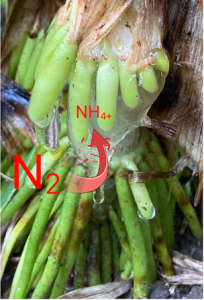
What the team found was remarkable. In Oaxaca, maize grown by Indigenous communities produced a thick, sugary mucilage around their roots, creating an ideal environment for nitrogen-fixing bacteria. Thanks to this microbial partnership, the plants obtained half of their nitrogen from the air on average, a striking contrast to most cereal crops grown elsewhere.
These concerns have pushed the Ané lab to seek alternatives to synthetic fertilizers to improve crop yields and mitigate environmental harm. Their approach focuses on a long-standing, yet currently underutilized relationship between plants and microbes – one that could reduce the need for fertilizer.
In nature, plant roots harbor bacteria that can capture nitrogen gas from the air, converting it to ammonia in a process called fixation. However, these microbes are often reluctant to share such a valuable resource with the plant.
“We want to make sure that bacteria deliver the nitrogen they fix,” explained Ané. “They do everything they can to use it and have no reason to share it with the plant.”
To address this, the lab works to engineer nitrogen-fixing bacteria to release more ammonia, increasing the amount available to crops. However, despite advances in genetic engineering, researchers in the field have historically achieved only modest improvements in bacterial nitrogen output.
“Frankly, evolution works very well, and I’m not sure how much we can improve this relationship from just the bacterial side,” he said. “So I was thinking, where else can I have an impact?”
The question led the team to shift focus to the plant side. In the United States, most cereal crops, like corn, get less than 1% of their nitrogen from microbial sources. What if crops themselves could also be engineered to become better hosts for the bacteria? To explore this idea, Ané and his colleagues turned to maize varieties grown for thousands of years without the use of fertilizer.
“We were just looking for anything that works in nature, that could work in nature,” he said. “And so, for corn, the idea was to go to the center of domestication, where these plants had first been domesticated in the world. If you are talking about corn, that’s the original state of Oaxaca in Mexico.”
What the team found was remarkable. In Oaxaca, maize grown by Indigenous communities produced a thick, sugary mucilage around their roots, creating an ideal environment for nitrogen-fixing bacteria. Thanks to this microbial partnership, the plants obtained half of their nitrogen from the air on average, a striking contrast to most cereal crops grown elsewhere.
 After years of follow-up experiments, Ané and his team were convinced that this observation was real. With the guidance and consent of Indigenous communities, they began working to breed this trait into corn varieties suited for U.S. agriculture.
Of course, adapting this system to large-scale agriculture presents challenges. The original maize thrives in a tropical climate and eight-month growing season – conditions very different from the Corn Belt. Additionally, the mucilage isn’t only home to nitrogen-fixers; it harbors a complex microbial community that functions as a unit.
Still, Ané and his team remained optimistic. At UW–Madison, researchers have successfully bred this trait into corn grown in Wisconsin – an important proof of concept for adapting it to new climates. The Ané lab is currently investigating the mechanisms that enable plants to produce mucilage and facilitate colonization of their roots by nitrogen-fixing bacteria. By understanding these critical interactions from both the microbial and plant side, they hope to unlock new methods to enhance this natural partnership, and expand it to new cropping systems, ultimately making agriculture more sustainable.
After years of follow-up experiments, Ané and his team were convinced that this observation was real. With the guidance and consent of Indigenous communities, they began working to breed this trait into corn varieties suited for U.S. agriculture.
Of course, adapting this system to large-scale agriculture presents challenges. The original maize thrives in a tropical climate and eight-month growing season – conditions very different from the Corn Belt. Additionally, the mucilage isn’t only home to nitrogen-fixers; it harbors a complex microbial community that functions as a unit.
Still, Ané and his team remained optimistic. At UW–Madison, researchers have successfully bred this trait into corn grown in Wisconsin – an important proof of concept for adapting it to new climates. The Ané lab is currently investigating the mechanisms that enable plants to produce mucilage and facilitate colonization of their roots by nitrogen-fixing bacteria. By understanding these critical interactions from both the microbial and plant side, they hope to unlock new methods to enhance this natural partnership, and expand it to new cropping systems, ultimately making agriculture more sustainable.
These concerns have pushed the Ané lab to seek alternatives to synthetic fertilizers to improve crop yields and mitigate environmental harm. Their approach focuses on a long-standing, yet currently underutilized relationship between plants and microbes – one that could reduce the need for fertilizer.
In nature, plant roots harbor bacteria that can capture nitrogen gas from the air, converting it to ammonia in a process called fixation. However, these microbes are often reluctant to share such a valuable resource with the plant.
“We want to make sure that bacteria deliver the nitrogen they fix,” explained Ané. “They do everything they can to use it and have no reason to share it with the plant.”
To address this, the lab works to engineer nitrogen-fixing bacteria to release more ammonia, increasing the amount available to crops. However, despite advances in genetic engineering, researchers in the field have historically achieved only modest improvements in bacterial nitrogen output.
“Frankly, evolution works very well, and I’m not sure how much we can improve this relationship from just the bacterial side,” he said. “So I was thinking, where else can I have an impact?”
The question led the team to shift focus to the plant side. In the United States, most cereal crops, like corn, get less than 1% of their nitrogen from microbial sources. What if crops themselves could also be engineered to become better hosts for the bacteria? To explore this idea, Ané and his colleagues turned to maize varieties grown for thousands of years without the use of fertilizer.
“We were just looking for anything that works in nature, that could work in nature,” he said. “And so, for corn, the idea was to go to the center of domestication, where these plants had first been domesticated in the world. If you are talking about corn, that’s the original state of Oaxaca in Mexico.”
What the team found was remarkable. In Oaxaca, maize grown by Indigenous communities produced a thick, sugary mucilage around their roots, creating an ideal environment for nitrogen-fixing bacteria. Thanks to this microbial partnership, the plants obtained half of their nitrogen from the air on average, a striking contrast to most cereal crops grown elsewhere.
After years of follow-up experiments, Ané and his team were convinced that this observation was real. With the guidance and consent of Indigenous communities, they began working to breed this trait into corn varieties suited for U.S. agriculture.
Of course, adapting this system to large-scale agriculture presents challenges. The original maize thrives in a tropical climate and eight-month growing season – conditions very different from the Corn Belt. Additionally, the mucilage isn’t only home to nitrogen-fixers; it harbors a complex microbial community that functions as a unit.
Still, Ané and his team remained optimistic. At UW–Madison, researchers have successfully bred this trait into corn grown in Wisconsin – an important proof of concept for adapting it to new climates. The Ané lab is currently investigating the mechanisms that enable plants to produce mucilage and facilitate colonization of their roots by nitrogen-fixing bacteria. By understanding these critical interactions from both the microbial and plant side, they hope to unlock new methods to enhance this natural partnership, and expand it to new cropping systems, ultimately making agriculture more sustainable.