Do microorganisms hold the key to environmental sustainability? Erica Majumder Aims to Find Out
This article, by Jessica Brown, is part of a series highlighting members of the Office of Sustainability’s Experts Database. In a collaboration with instructor Hannah Monroe’s course, LSC 561: Writing Science for the Public, students interviewed campus sustainability experts and produced short feature stories.
They say one person’s trash is another person’s treasure, and that is certainly the case for a group of researchers at University of Wisconsin–Madison aiming to find new ways to upcycle waste through the power of microorganisms.
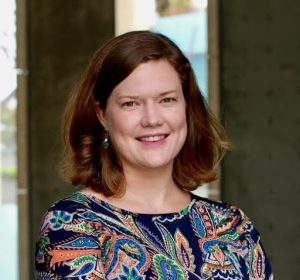 This group of researchers, led by microbial biochemist Dr. Erica Majumder, uses a comprehensive biological approach to study the interaction between microorganisms and the environment. By understanding microorganisms and how they behave within environment systems, the group hopes to develop practical strategies to reduce environmental pollution and transform waste into useful resources.
Majumder’s passion for environmental sustainability started at a young age. Growing up in Missouri, she experienced first-hand the environmental devastation that can result from lead mining. Even at a young age she recognized the need for technical solutions to remove mining waste from the environment, making it healthier for those that depend on the natural resources for survival. As she progressed in her academic and professional career, she began to not only think about ways to remove waste from the environment but also how to repurpose it into something useful.
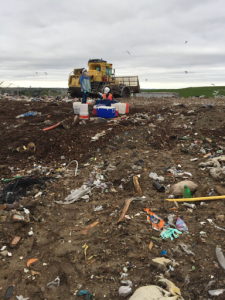
Broadly, Majumder described her area of research as “waste management microbiology.” Her group conducts research on a variety of different topics including the ecological interaction between microplastics and harmful algae blooms, enhanced wastewater treatment, and the degradation of plastics in the environment. Some of their recent work in landfill microbiology has even gained the attention of solid waste management services here in Dane County.
“Landfills are all about microbial activity, yet we do pretty much nothing to control the microbes that are there,” said Majumder. “Similar to how we put probiotics in yogurt to control the microbes in our gut, it would be possible to design a probiotic or fertilizer to manipulate that ecosystem.”
This area of research is particularly exciting for the group because, unlike some mining bioremediation, or clean-up projects, where they are limited in what they can do, the possibilities within landfill management are endless and have significant implications for sustainability.
This group of researchers, led by microbial biochemist Dr. Erica Majumder, uses a comprehensive biological approach to study the interaction between microorganisms and the environment. By understanding microorganisms and how they behave within environment systems, the group hopes to develop practical strategies to reduce environmental pollution and transform waste into useful resources.
Majumder’s passion for environmental sustainability started at a young age. Growing up in Missouri, she experienced first-hand the environmental devastation that can result from lead mining. Even at a young age she recognized the need for technical solutions to remove mining waste from the environment, making it healthier for those that depend on the natural resources for survival. As she progressed in her academic and professional career, she began to not only think about ways to remove waste from the environment but also how to repurpose it into something useful.
Broadly, Majumder described her area of research as “waste management microbiology.” Her group conducts research on a variety of different topics including the ecological interaction between microplastics and harmful algae blooms, enhanced wastewater treatment, and the degradation of plastics in the environment. Some of their recent work in landfill microbiology has even gained the attention of solid waste management services here in Dane County.
“Landfills are all about microbial activity, yet we do pretty much nothing to control the microbes that are there,” said Majumder. “Similar to how we put probiotics in yogurt to control the microbes in our gut, it would be possible to design a probiotic or fertilizer to manipulate that ecosystem.”
This area of research is particularly exciting for the group because, unlike some mining bioremediation, or clean-up projects, where they are limited in what they can do, the possibilities within landfill management are endless and have significant implications for sustainability.
 Collaboration has been key to the success of the Majumder lab, working with researchers all over campus from Animal & Dairy Sciences to Civil & Environmental Engineering. Some examples of these collaborations include work done with the Center for Dairy Research Dairy Business Innovation Alliance (DBIA) to improve the conversion of acid whey, a byproduct of the dairy industry, to a fully biodegradable plastic, and work done with the engineering department to design wave simulating water tanks used to study the interaction between microplastics and harmful algae blooms in the great lakes. Majumder attributed the collaborative nature of her research program to the interdisciplinary training she received during her Ph.D. at Washington University in St. Louis and Post Doctorate at University of Missouri-Columbia and The Scripps Research Institute. As she described it, “we do basic science, but with an applied lens”, meaning they answer the fundamental scientific questions and work with collaborators to develop practical applications.
Looking towards the future, Majumder hopes to continue bridging the gap between basic science and tangible real-world problems. Using their knowledge of microbial ecology within systems, like landfills and groundwater, the group hopes to develop and test different intervention strategies to both confirm their earlier findings and explore potential interventions that can improve sustainability.
Majumder said for her group, sustainability is all about “not seeing waste as waste, but more as residuals that can feed into other processes.” She hopes to leverage the metabolic power of microorganisms “to enable this idea of a circular economy where you would ideally have no waste.”
Collaboration has been key to the success of the Majumder lab, working with researchers all over campus from Animal & Dairy Sciences to Civil & Environmental Engineering. Some examples of these collaborations include work done with the Center for Dairy Research Dairy Business Innovation Alliance (DBIA) to improve the conversion of acid whey, a byproduct of the dairy industry, to a fully biodegradable plastic, and work done with the engineering department to design wave simulating water tanks used to study the interaction between microplastics and harmful algae blooms in the great lakes. Majumder attributed the collaborative nature of her research program to the interdisciplinary training she received during her Ph.D. at Washington University in St. Louis and Post Doctorate at University of Missouri-Columbia and The Scripps Research Institute. As she described it, “we do basic science, but with an applied lens”, meaning they answer the fundamental scientific questions and work with collaborators to develop practical applications.
Looking towards the future, Majumder hopes to continue bridging the gap between basic science and tangible real-world problems. Using their knowledge of microbial ecology within systems, like landfills and groundwater, the group hopes to develop and test different intervention strategies to both confirm their earlier findings and explore potential interventions that can improve sustainability.
Majumder said for her group, sustainability is all about “not seeing waste as waste, but more as residuals that can feed into other processes.” She hopes to leverage the metabolic power of microorganisms “to enable this idea of a circular economy where you would ideally have no waste.”
This group of researchers, led by microbial biochemist Dr. Erica Majumder, uses a comprehensive biological approach to study the interaction between microorganisms and the environment. By understanding microorganisms and how they behave within environment systems, the group hopes to develop practical strategies to reduce environmental pollution and transform waste into useful resources.
Majumder’s passion for environmental sustainability started at a young age. Growing up in Missouri, she experienced first-hand the environmental devastation that can result from lead mining. Even at a young age she recognized the need for technical solutions to remove mining waste from the environment, making it healthier for those that depend on the natural resources for survival. As she progressed in her academic and professional career, she began to not only think about ways to remove waste from the environment but also how to repurpose it into something useful.
Broadly, Majumder described her area of research as “waste management microbiology.” Her group conducts research on a variety of different topics including the ecological interaction between microplastics and harmful algae blooms, enhanced wastewater treatment, and the degradation of plastics in the environment. Some of their recent work in landfill microbiology has even gained the attention of solid waste management services here in Dane County.
“Landfills are all about microbial activity, yet we do pretty much nothing to control the microbes that are there,” said Majumder. “Similar to how we put probiotics in yogurt to control the microbes in our gut, it would be possible to design a probiotic or fertilizer to manipulate that ecosystem.”
This area of research is particularly exciting for the group because, unlike some mining bioremediation, or clean-up projects, where they are limited in what they can do, the possibilities within landfill management are endless and have significant implications for sustainability.
Collaboration has been key to the success of the Majumder lab, working with researchers all over campus from Animal & Dairy Sciences to Civil & Environmental Engineering. Some examples of these collaborations include work done with the Center for Dairy Research Dairy Business Innovation Alliance (DBIA) to improve the conversion of acid whey, a byproduct of the dairy industry, to a fully biodegradable plastic, and work done with the engineering department to design wave simulating water tanks used to study the interaction between microplastics and harmful algae blooms in the great lakes. Majumder attributed the collaborative nature of her research program to the interdisciplinary training she received during her Ph.D. at Washington University in St. Louis and Post Doctorate at University of Missouri-Columbia and The Scripps Research Institute. As she described it, “we do basic science, but with an applied lens”, meaning they answer the fundamental scientific questions and work with collaborators to develop practical applications.
Looking towards the future, Majumder hopes to continue bridging the gap between basic science and tangible real-world problems. Using their knowledge of microbial ecology within systems, like landfills and groundwater, the group hopes to develop and test different intervention strategies to both confirm their earlier findings and explore potential interventions that can improve sustainability.
Majumder said for her group, sustainability is all about “not seeing waste as waste, but more as residuals that can feed into other processes.” She hopes to leverage the metabolic power of microorganisms “to enable this idea of a circular economy where you would ideally have no waste.”