The Living Lab on Lake Monona’s Shore
On warm days along Lake Monona, walkers and cyclists pass a steady stream of traffic on John Nolen Drive. Every so often, they also pass something unexpected: UW–Madison students carrying bright green Menards buckets and collecting water from the lake.
The story behind these buckets starts in August of 2023, when the City of Madison chose the design firm Sasaki to establish an ecologically vibrant living edge along Lake Monona’s waterfront. This project hopes to forge connections to the water, expand recreational options, improve water quality, and provide an ecologically healthy shoreline for wildlife. A tall order for a highly concretized and urban waterfront.
 When Anna Bierbrauer, an Assistant Professor in Planning and Landscape Architecture, got involved in the stormwater runoff management aspect of this project, she saw the potential for it to turn into a living lab for UW–Madison faculty and students to put their time, resources, and knowledge to work helping the community. Bierbrauer got involved early on, reaching out to Sasaki when she realized there was a project, trying to figure out “how my landscape architecture studio could plug into the project.” From the outset, there was potential for an interdisciplinary living lab.
 Some readers may have already noticed that John Nolen Drive is being revitalized, no doubt from the disruptive and inconvenient construction on their morning and evening commutes. This specific corridor is being prioritized as a result of federal infrastructure funding, but also provides an interesting research opportunity.
The list of collaborators ballooned even further when Bierbrauer had a chance interaction with Peter Jaeger, the Chemistry department’s Community Outreach Manager, at a mixer. From this casual conversation, an interdisciplinary community-engaged research project was born. Jaeger brought Ryan Stowe, Assistant Professor of Chemistry, on board, who believes his role “is part of a larger story of how the chemistry department outreach is evolving” from being more “internal focused” to more “community focused.” The Chemistry department, Stowe tells me, has been insular in some ways, but he’s hoping for a fundamental shift in the way chemistry is taught.
Students need to learn not only the fundamentals of their disciplines, but also the messy, real-world applications of them. Jaeger and Stowe realized that this was a great project to build a course around: to teach students how to use their knowledge to contribute to real-world decisions.
To make this vision into a reality, they approached Analytical Lab Director Amanda Buchberger to see whether building a testing protocol and analyzing stormwater runoff may fit into her Fundamentals of Analytical Science course. In short order, over 200 undergraduate students were mobilized over a 10-week period to collect shoreline water samples. They were armed with detailed instructions and a bright green bucket.
Buchberger describes her role as “on the ground, doing the chemistry.” Once her students gather the water samples, Buchberger directs them to analyze the samples in class for phosphorus. But later, Buchberger directs a dedicated, smaller group of eight undergraduate students to further analyze the samples for phosphorus, ammonia, chloride, nitrates, and heavy metals. Madison’s lakes are among the most studied in the world, thanks largely to UW’s Center for Limnology. But surprisingly little data exists from the shoreline itself. So this analysis will fill an important gap in the knowledge we have about Monona, showing us how runoff is affecting shoreline water quality and to what extent green infrastructure can limit that impact.
Some readers may have already noticed that John Nolen Drive is being revitalized, no doubt from the disruptive and inconvenient construction on their morning and evening commutes. This specific corridor is being prioritized as a result of federal infrastructure funding, but also provides an interesting research opportunity.
The list of collaborators ballooned even further when Bierbrauer had a chance interaction with Peter Jaeger, the Chemistry department’s Community Outreach Manager, at a mixer. From this casual conversation, an interdisciplinary community-engaged research project was born. Jaeger brought Ryan Stowe, Assistant Professor of Chemistry, on board, who believes his role “is part of a larger story of how the chemistry department outreach is evolving” from being more “internal focused” to more “community focused.” The Chemistry department, Stowe tells me, has been insular in some ways, but he’s hoping for a fundamental shift in the way chemistry is taught.
Students need to learn not only the fundamentals of their disciplines, but also the messy, real-world applications of them. Jaeger and Stowe realized that this was a great project to build a course around: to teach students how to use their knowledge to contribute to real-world decisions.
To make this vision into a reality, they approached Analytical Lab Director Amanda Buchberger to see whether building a testing protocol and analyzing stormwater runoff may fit into her Fundamentals of Analytical Science course. In short order, over 200 undergraduate students were mobilized over a 10-week period to collect shoreline water samples. They were armed with detailed instructions and a bright green bucket.
Buchberger describes her role as “on the ground, doing the chemistry.” Once her students gather the water samples, Buchberger directs them to analyze the samples in class for phosphorus. But later, Buchberger directs a dedicated, smaller group of eight undergraduate students to further analyze the samples for phosphorus, ammonia, chloride, nitrates, and heavy metals. Madison’s lakes are among the most studied in the world, thanks largely to UW’s Center for Limnology. But surprisingly little data exists from the shoreline itself. So this analysis will fill an important gap in the knowledge we have about Monona, showing us how runoff is affecting shoreline water quality and to what extent green infrastructure can limit that impact.
 Buchberger and Bierbrauer both emphasize that the work is not without its challenges. One of the very first weeks, a student dropped their bucket into the lake, and helplessly watched it sink. Any chemistry done outside a lab opens the doors for these types of hurdles. Buchberger explains that the logistics of making sure samples are collected every single week are substantial, but it worked by trusting her students.
 But the living lab has benefits worth its challenges. Even as buckets were lost and students were horrified by how “gross” the water sometimes was, Buchberger describes the experience as “super special.” She says, “The fact that we can bring it to a point of ‘it’s hard, but we’re doing it for an important reason,’ is really special” Bierbrauer echoes this, saying students tend to be more engaged and interested when they know it’s not a fictional problem, and that their work is actually helping the community.
Bierbrauer’s work is aided by the undergraduate students in her Plants and Ecology Design class, and Rusal Ferus, a graduate project assistant. Both Bierbrauer and Ferus are interested in how people experience and interact with a landscape, and so when the student who dropped their bucket in the lake sent in a photo, a metaphorical lightbulb went off. Bierbrauer and Ferus realized they should start asking for photos and so students began to take photos and make qualitative observations. Bierbrauer commented that having “two very different kinds of eyes on the site” was valuable.
But the living lab has benefits worth its challenges. Even as buckets were lost and students were horrified by how “gross” the water sometimes was, Buchberger describes the experience as “super special.” She says, “The fact that we can bring it to a point of ‘it’s hard, but we’re doing it for an important reason,’ is really special” Bierbrauer echoes this, saying students tend to be more engaged and interested when they know it’s not a fictional problem, and that their work is actually helping the community.
Bierbrauer’s work is aided by the undergraduate students in her Plants and Ecology Design class, and Rusal Ferus, a graduate project assistant. Both Bierbrauer and Ferus are interested in how people experience and interact with a landscape, and so when the student who dropped their bucket in the lake sent in a photo, a metaphorical lightbulb went off. Bierbrauer and Ferus realized they should start asking for photos and so students began to take photos and make qualitative observations. Bierbrauer commented that having “two very different kinds of eyes on the site” was valuable.
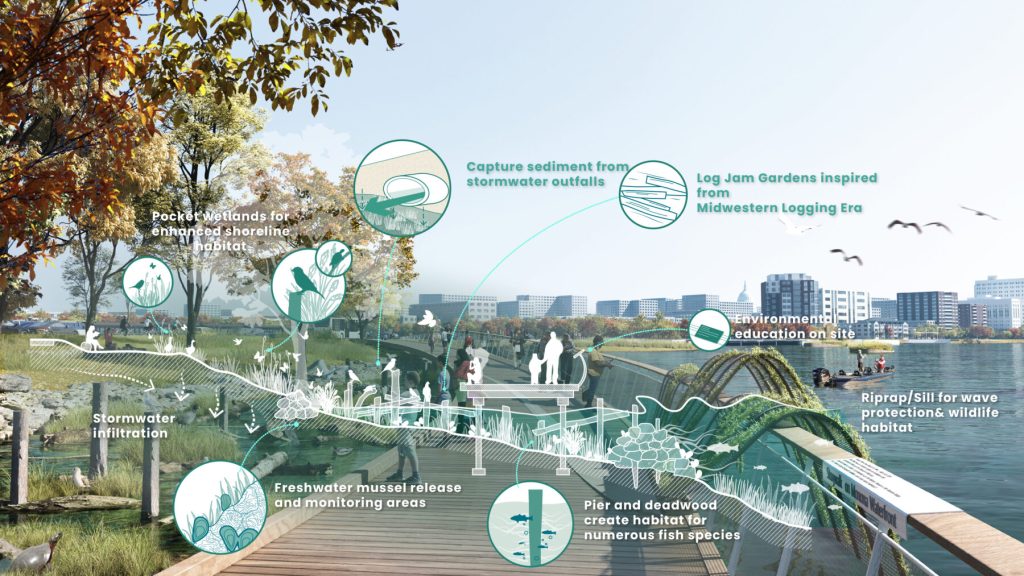
Sasaki’s conception of the various components of Lake Monona’s ‘living edge.’ Photo from Sasaki.
“We expanded the conversation to include more partners from the City of Madison, including colleagues in Chemistry, and started thinking longer-term. There was real enthusiasm around how chemistry students could get involved and contribute to the project in a meaningful way. That’s when it became clear that collecting baseline environmental data—what conditions look like before construction—would be critical for understanding how well the design performs over time. A community-based research grant from Water@UW helped us get the collaboration off the ground.” -Anna BierbrauerHer first question was: “What can I, as a researcher, do in support?” One answer was to look to this unique stretch of land to develop best practices for other green infrastructure projects such as this one. As she explained, “John Nolen Drive is about as tough as it gets—road salt, heat off the pavement, heavy traffic, strong winds, and barely any room to work with. That’s exactly why it matters. If green infrastructure can survive and function here—capturing stormwater and supporting healthy trees—it can work almost anywhere. It’s a real-world stress test for designing greener, more resilient streets that also make the corridor better for people walking and biking.”
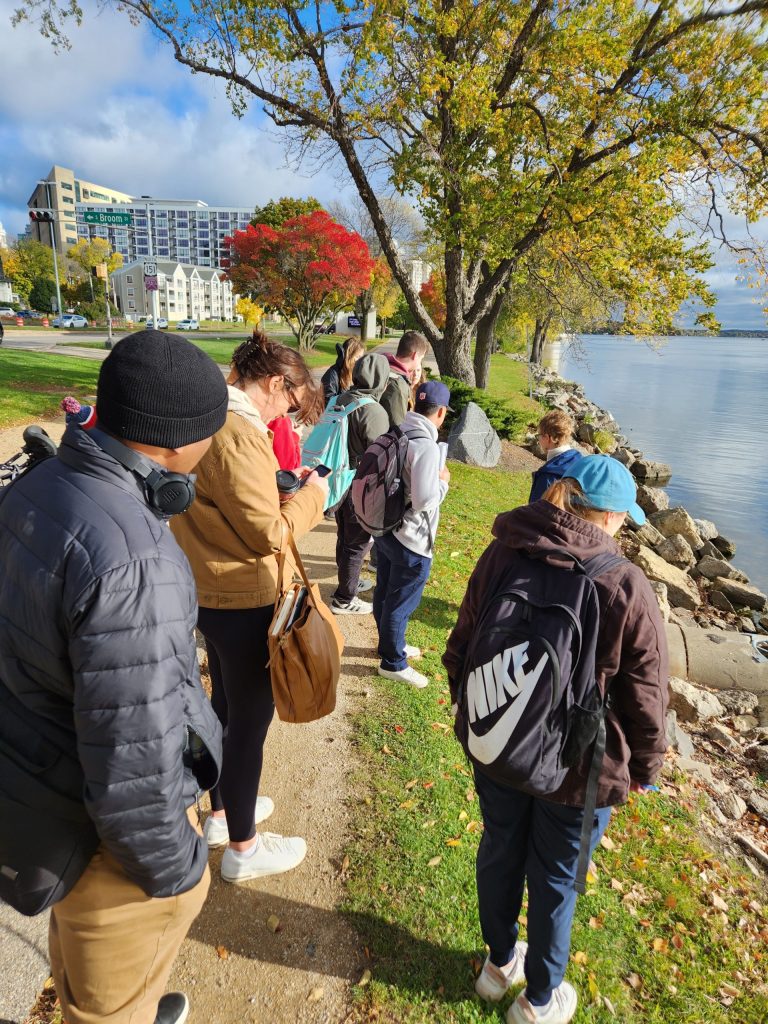
A group of Dr. Bierbrauer’s students next to Lake Monona. Photo by Dr. Bierbrauer.
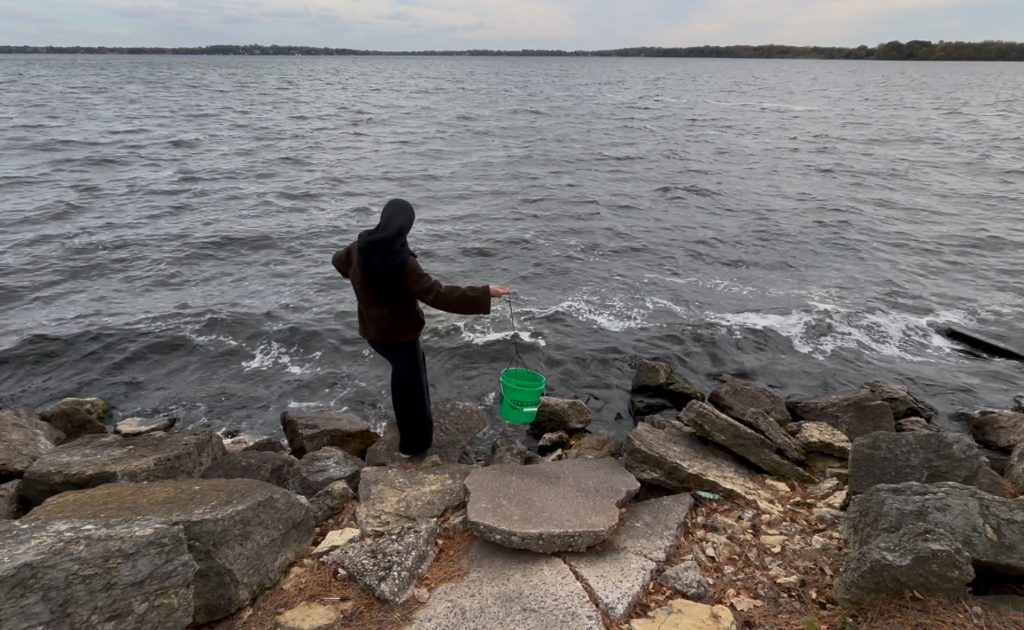
A student from Dr. Buchberger’s class sampling water. Photo from Dr. Bierbrauer.
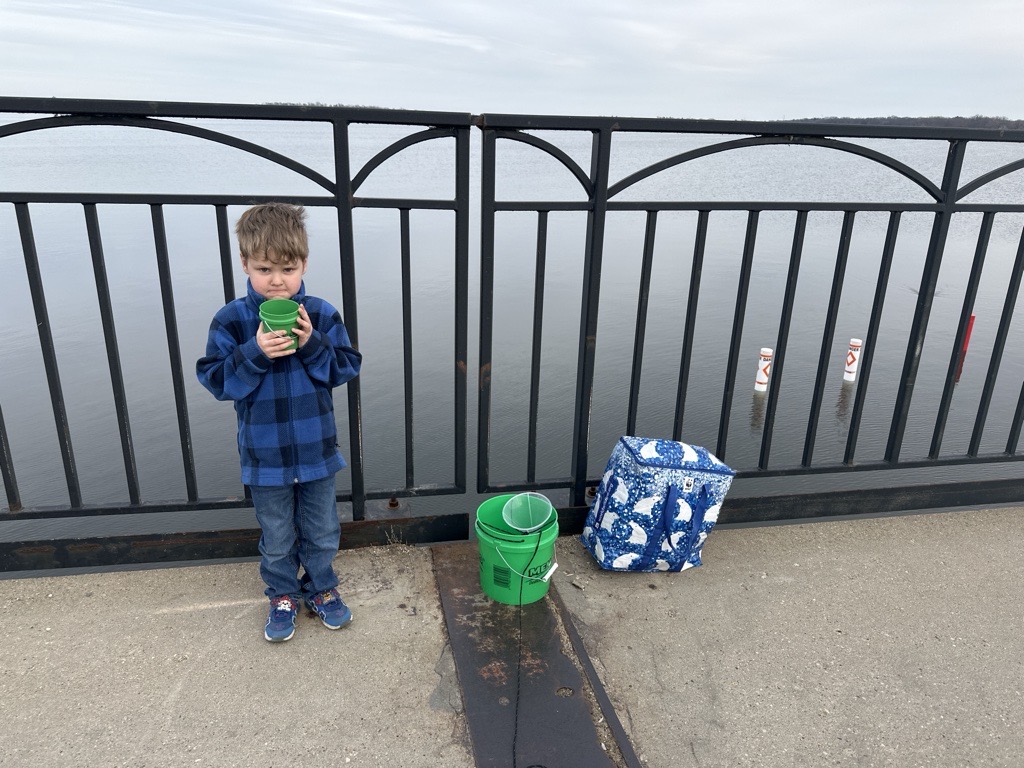
Dr. Buchberger’s child assisting with water sampling. Photo by Dr. Buchberger.
“Landscape architecture students are trained to notice things like layout, materials, and how spaces are designed to be used, so their photos tend to reflect that way of seeing. The chemistry students came in without that training—and without much direction on what to photograph. They just documented what stood out to them. What they captured was often less about ‘design’ and more about experience: where people linger, how they move through the space, what catches their attention, what feels important in the moment. Put together, those two perspectives gave us a fuller picture. One shows how the space is designed to work; the other shows how it’s actually lived in.” -Anna BierbrauerThis project, while with its own hurdles, demonstrates the value in working across disciplines to achieve results. Bierbrauer and Buchberger both acknowledged that there’s a difference in workflow and thought processes between STEM and the humanities, but that difference creates potential for innovative methods and, eventually, findings. Buchberger says: “I feel incredibly fortunate that Anna (Bierbrauer) is my collaborator because we both come at things from different perspectives but we communicate well.” This project is only in its early stages. The hope is for water quality monitoring to continue for the next three to five years as the “living edge” is built along the waterfront. Bierbrauer and Ferus also discussed plans to create a community portal showcasing data collected from water quality monitoring, qualitative observations, and ecological assessments along John Nolen Drive. Most importantly, this living lab can still engage even more with Madison residents. Bierbrauer, Buchberger, and Ferus hope they can continue to facilitate undergraduate students in interfacing with the community and local government partners and find more ways to implement the Wisconsin Idea. By: Laleh Ahmad