Sustainability Research Hub One Year Later: Expanding Cross-Campus Collaboration
In February 2024, UW–Madison Chancellor Jennifer L. Mnookin announced an ambitious set of environmental goals for campus. While several of these efforts focused on facilities and infrastructure, they also prioritized the teaching and research mission of the university. From there, the Sustainability Research Hub was born. A little over a year later, the team is navigating a shifting research landscape while still living into its vision and building a campus research community.
 A joint effort between the Nelson Institute for Environmental Studies and the Office of Sustainability, its goal is to make UW–Madison a “preeminent destination for sustainability research.” Its central funding source makes it uniquely positioned to serve faculty in all schools and colleges —in any discipline that speaks to environmental sustainability — with research development and proposal support. Along with research administrators and writers, the Hub has a research collaboration specialist who makes connections with campus stakeholders at all levels. This team allows the Hub to serve as a connector and collaborator, creating a vibrant research development community that supports efforts campus-wide.
“We all know this campus has a spectacular range of expertise, and we also know our faculty love to work together across disciplines. So, why doesn’t it happen more?” says Paul Robbins, dean of the Nelson Institute. “The Hub does the hard transactional work of bringing people together so that they can unleash their desire to collaborate. That’s a unique sustainability mission on a unique sustainability campus.”
A joint effort between the Nelson Institute for Environmental Studies and the Office of Sustainability, its goal is to make UW–Madison a “preeminent destination for sustainability research.” Its central funding source makes it uniquely positioned to serve faculty in all schools and colleges —in any discipline that speaks to environmental sustainability — with research development and proposal support. Along with research administrators and writers, the Hub has a research collaboration specialist who makes connections with campus stakeholders at all levels. This team allows the Hub to serve as a connector and collaborator, creating a vibrant research development community that supports efforts campus-wide.
“We all know this campus has a spectacular range of expertise, and we also know our faculty love to work together across disciplines. So, why doesn’t it happen more?” says Paul Robbins, dean of the Nelson Institute. “The Hub does the hard transactional work of bringing people together so that they can unleash their desire to collaborate. That’s a unique sustainability mission on a unique sustainability campus.”
 When Luca Mastropasqua, assistant professor of mechanical engineering, and Song Jin, professor of chemistry, attended a Hub-hosted event about a Department of Energy funding opportunity, they were strangers. Now, they’re working together on a proposal entitled Development of an Integrated Membrane and ElectroChemical System (IMECS) for water extraction and lithium recovery from produced water. At the event, they learned that — though based in different departments — their work on selective recovery of Lithium from seawater and wastewater streams was closely related. On a campus of more than 2,500 faculty, it can be hard to connect with others. The Hub is committed to bridging those divides and creating space to connect. “The Hub allowed us to connect to find synergistic capabilities and common research interests,” Mastropasqua said. “They helped us with proposal writing and even supported our interactions with an external industrial partner.”
The Hub is dedicated to making connections. When Shanon Hankin joined CALS as a research program coordinator, associate dean of research Troy Runge introduced her to the Hub team right away. “By teaming up with the Hub over the past year, CALS was able to provide more services for our PIs than would otherwise be possible,” Hankin shares. “We have built a highly collaborative relationship structured around information sharing and co-learning that increases the quality of the research proposals while reducing the burden on PIs, especially for large grants.” Through open communication between administrative teams, these collaborations can provide additional capacity and services to support researchers.
Creating Community
When Luca Mastropasqua, assistant professor of mechanical engineering, and Song Jin, professor of chemistry, attended a Hub-hosted event about a Department of Energy funding opportunity, they were strangers. Now, they’re working together on a proposal entitled Development of an Integrated Membrane and ElectroChemical System (IMECS) for water extraction and lithium recovery from produced water. At the event, they learned that — though based in different departments — their work on selective recovery of Lithium from seawater and wastewater streams was closely related. On a campus of more than 2,500 faculty, it can be hard to connect with others. The Hub is committed to bridging those divides and creating space to connect. “The Hub allowed us to connect to find synergistic capabilities and common research interests,” Mastropasqua said. “They helped us with proposal writing and even supported our interactions with an external industrial partner.”
The Hub is dedicated to making connections. When Shanon Hankin joined CALS as a research program coordinator, associate dean of research Troy Runge introduced her to the Hub team right away. “By teaming up with the Hub over the past year, CALS was able to provide more services for our PIs than would otherwise be possible,” Hankin shares. “We have built a highly collaborative relationship structured around information sharing and co-learning that increases the quality of the research proposals while reducing the burden on PIs, especially for large grants.” Through open communication between administrative teams, these collaborations can provide additional capacity and services to support researchers.
Creating Community
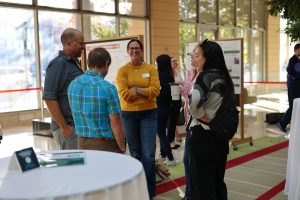 In addition to connecting researchers, the Hub also works with other research development entities on campus to unite efforts. “A research university thrives when brilliant minds converge — not in isolation, but in collaboration,” says Dorota Brzezinska, vice chancellor for research. “A central hub ignites this synergy, turning bold ideas into breakthroughs that shape the world’s future.” A recent example of centralizing efforts is the Research Development Community of Practice (CoP). There are a variety of teams housed in colleges and divisions aimed at supporting research development and community building, including Collective for Research Impact and Social Partnerships (College of Letters & Science), Research Services Office (College of Engineering), MedRISE (School of Medicine and Public Health), Wisconsin Energy Institute, and the Wisconsin Center for Education Research (School of Education), among others. Alongside Lauren Gee in the School of Medicine and Public Health and Shanon Hankin in the College of Agricultural and Life Sciences, the Hub co-led the creation of the CoP to help bring together expertise, share ideas, and identify ways to work together. The community currently has over 100 participants.
Broad Support
In addition to connecting researchers, the Hub also works with other research development entities on campus to unite efforts. “A research university thrives when brilliant minds converge — not in isolation, but in collaboration,” says Dorota Brzezinska, vice chancellor for research. “A central hub ignites this synergy, turning bold ideas into breakthroughs that shape the world’s future.” A recent example of centralizing efforts is the Research Development Community of Practice (CoP). There are a variety of teams housed in colleges and divisions aimed at supporting research development and community building, including Collective for Research Impact and Social Partnerships (College of Letters & Science), Research Services Office (College of Engineering), MedRISE (School of Medicine and Public Health), Wisconsin Energy Institute, and the Wisconsin Center for Education Research (School of Education), among others. Alongside Lauren Gee in the School of Medicine and Public Health and Shanon Hankin in the College of Agricultural and Life Sciences, the Hub co-led the creation of the CoP to help bring together expertise, share ideas, and identify ways to work together. The community currently has over 100 participants.
Broad Support
 Beyond building connections and capacity with people, the Hub also supports institutional-level proposals, including UW–Madison’s involvement in a recent NSF Regional Innovations Engines project. The proposal was led by WiSys and has a 10-year budget potential of $160 million. The Forward Agriculture proposal centered on building an ecosystem around a circular bioeconomy with engagement from campus researchers, technology transfer offices, corporate engagement, team science, and others. Still under review, the proposal was recently named one of 29 semi-finalists from across the country.
“The Hub was a huge support for our Engines application. Their team helped connect groups and leadership across campus, and with external partners as well. This was an extremely complex proposal, and it wouldn’t have been possible to submit a strong application without their support,” said Brad Bolling, professor of food science and the proposal’s campus lead. “The institutional support for the Hub makes it possible to work across disciplines and support the pursuit of transformative opportunities.”
Beyond building connections and capacity with people, the Hub also supports institutional-level proposals, including UW–Madison’s involvement in a recent NSF Regional Innovations Engines project. The proposal was led by WiSys and has a 10-year budget potential of $160 million. The Forward Agriculture proposal centered on building an ecosystem around a circular bioeconomy with engagement from campus researchers, technology transfer offices, corporate engagement, team science, and others. Still under review, the proposal was recently named one of 29 semi-finalists from across the country.
“The Hub was a huge support for our Engines application. Their team helped connect groups and leadership across campus, and with external partners as well. This was an extremely complex proposal, and it wouldn’t have been possible to submit a strong application without their support,” said Brad Bolling, professor of food science and the proposal’s campus lead. “The institutional support for the Hub makes it possible to work across disciplines and support the pursuit of transformative opportunities.”
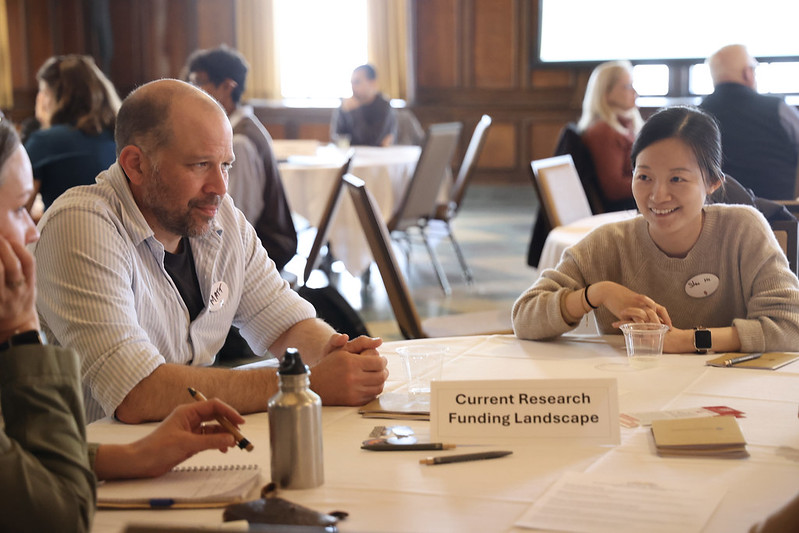
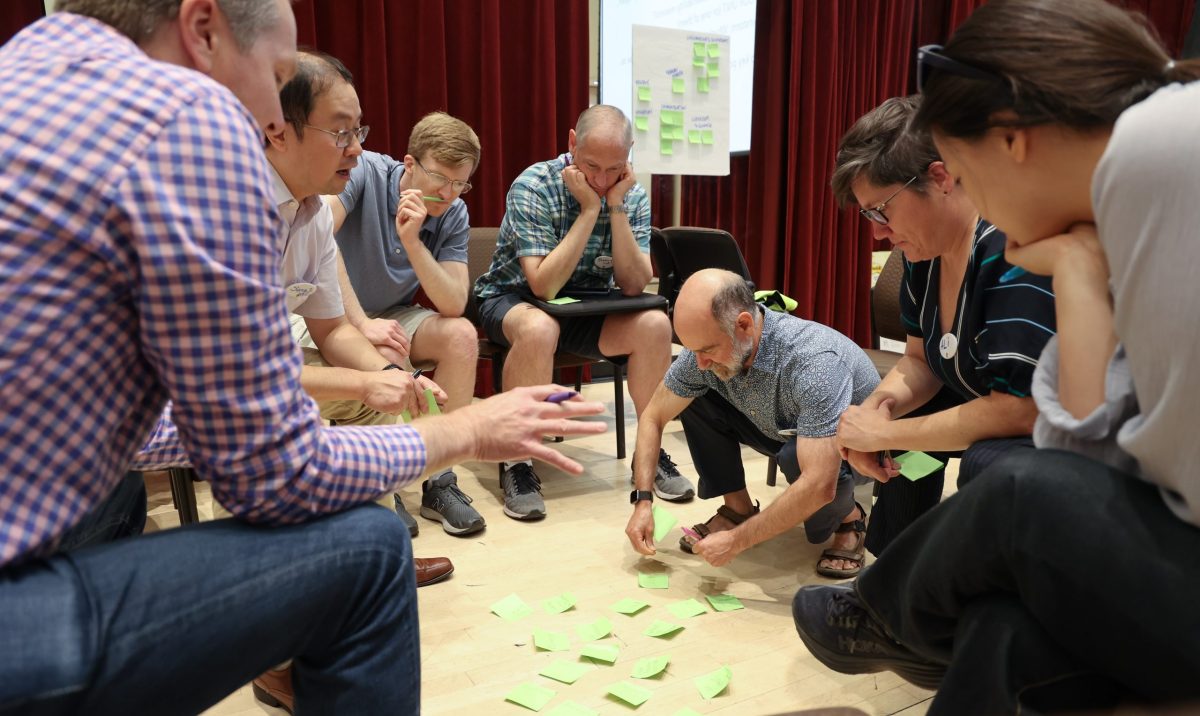
Hero Image: Researchers participate in a breakout session during the Hub’s Sustainability Research Visioning Event.
The Sustainability Research Hub team.
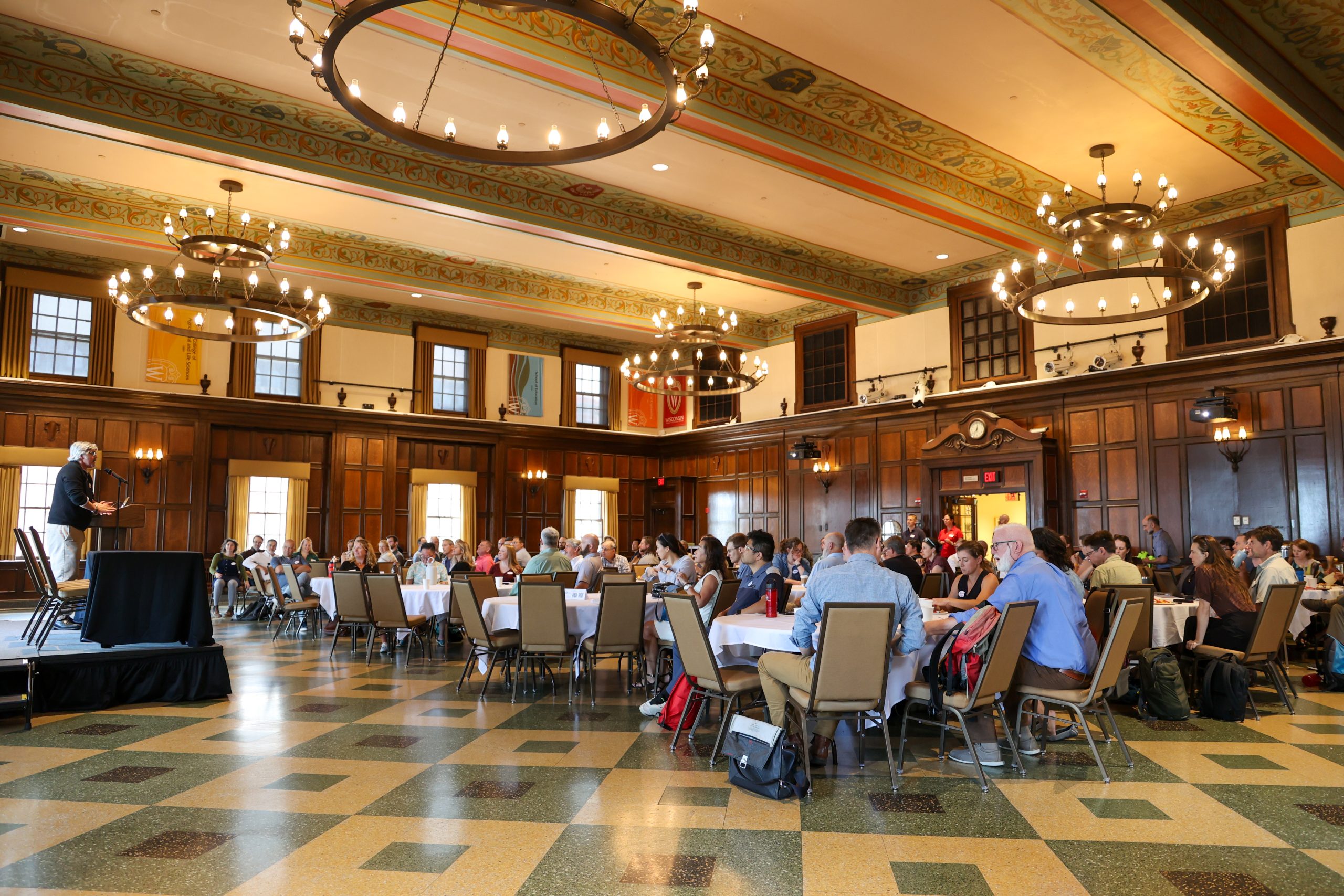
Dean Paul Robbins speaks at the fall 2024 Sustainability Research Visioning Event.
Success Stories
Connecting PeopleLuca Mastropasqua co-hosts a session on “RISE–EARTH: Technology” at the Hub’s 2024 Research Visioning Event.
Members of the Hub team connect with attendees at the Office of Sustainability’s third annual Sustainability Symposium.
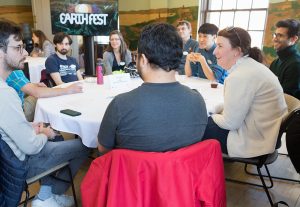
Participants gather for a networking session during Earth Fest 2024.
Matt Ginder-Vogel, Associate Director of Sustainability Research and Innovation, joins a discussion on funding strategies during a Sustainability Research Networking Event on Earth Day 2025. Photo by Chelsea Rademacher
Looking Ahead
In the current funding environment, supporting collaboration and proposal competitiveness are more important than ever. Hub staff are working to better understand the landscape of foundation and corporate support for sustainability research and coordinating with the Office of Business Engagement and the Wisconsin Foundation and Alumni Association Foundation Relations Program to identify what gaps might exist on campus. Efforts are also underway to find new ways to strengthen interdisciplinary sustainability research, including engagement with and support for the RISE faculty joining the UW–Madison community. “We are grateful to the Sustainability Research Hub for being such a nucleus on campus and for providing critical administrative support to pursue large grants, connecting environmental sustainability research and education on campus and beyond, and creating opportunities for our future researchers — our undergraduate and graduate students — to excel in the sustainability space,” says Brzezinska. During moments of uncertainty, it is vital to continue to find new ways to work together, support high-quality research, and move towards our common goals. The Sustainability Research Hub helps us do just that. By Eliza WatersHero Image: Researchers participate in a breakout session during the Hub’s Sustainability Research Visioning Event.