Intern Column: The CSA Subscription Box
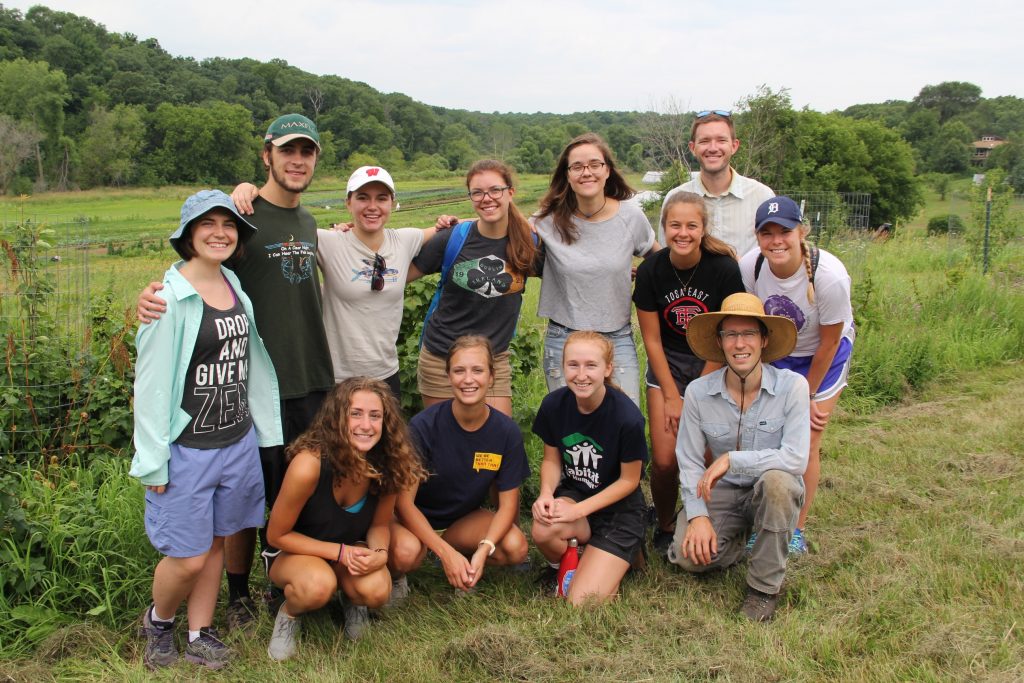
The Office of Sustainability interns visited the Farley Center this summer. Photo By: Trina La Susa
What is CSA?
CSA, or Community Supported Agriculture, is a way of getting the freshest local produce directly from the farm to the consumer. You could think of it as a kind of subscription box: participants buy a “membership” at the beginning of the growing season and receive a box of items every week until the farm is done producing for the year. CSA has been around for over 25 years, and there are many variations: some farms assemble the baskets for members, some allow members to fill their own with the produce of their choice, and some CSA operations even include other farm-fresh items like meat or eggs. Despite all these variations, there is one constant: every CSA program helps to close the gap between the producer and the consumer. This is crucial in our society where we often have no idea where our food comes from, which allows us to turn a blind eye to the agricultural, ethical, and environmental issues that may be involved in its production. One distinct difference between the CSA model and a typical grocery store or farmers market is that CSA participants purchase their “membership” at the beginning of the growing season. This creates something known as “shared risk:” because members of a CSA pay up front, they’ve invested in the growing season of the farm, whether it turns out to be successful or not. It’s a small financial risk for CSA members, but it can be a lifesaver for farmers who stand to lose much of their income if disaster strikes their crops. Shared risk helps build community between the CSA members and the farmer; if a storm topples the tomato plants, for instance, everyone joins together in rooting for the fall squashes and pumpkins. Through this strategy, CSA closes the gap between the producer and consumer by causing the consumer to have interest in the well-being of the farm and its crops. Additionally, by requiring members to pay up front, farmers ensure that they have buyers for their produce throughout the season, and they don’t have to focus on advertising or traveling to farmers markets on top of long days in the field during the growing season. Another distinction between CSA and conventional grocery stores is that being a part of a CSA often allows you to meet the people growing your food. Many CSA operations even encourage visits to the farm so that members can gain a greater understanding of their food and an appreciation for the effort which goes into its production. This is a unique opportunity to see where your food comes from, to ask about growing practices, and even to tell the farmer which veggie is your favorite. Perhaps they’ll grow more of that variety for you next year!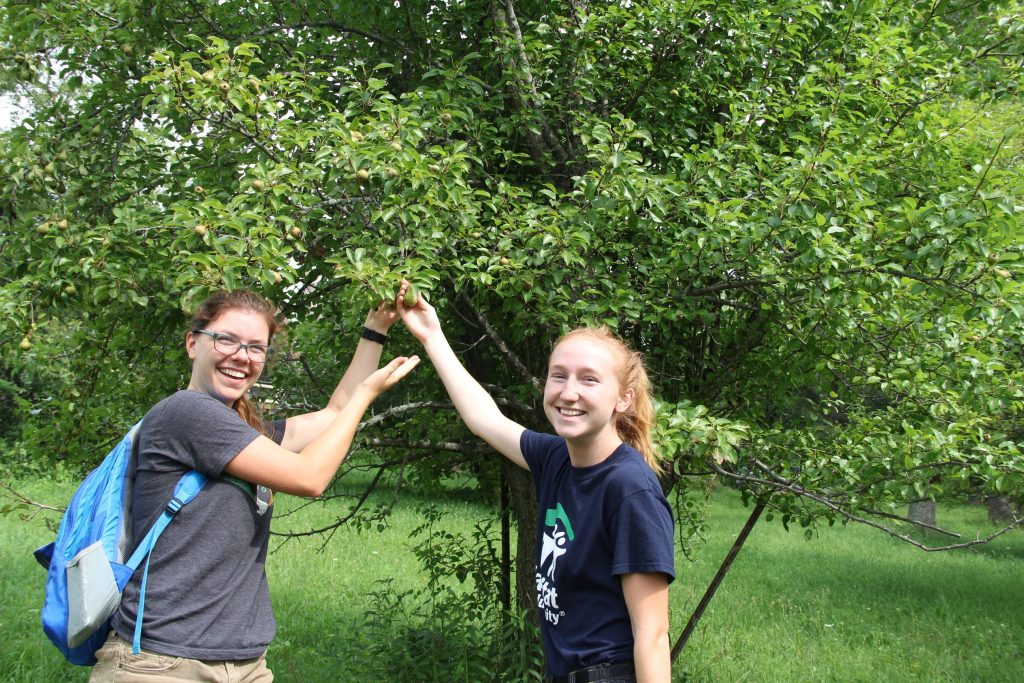
Interns Hannah Kasun and Natalie Brunner stand under a fruit tree at the Farley Center. Photo By: Trina La Susa
Lessen your impact on the environment, heighten the impact of your cooking
Closing the physical gap between producer and consumer has exciting environmental implications: since CSAs operate locally, this guarantees that the food distributed through the program is almost always local and in season. The hometown of your food may not sound like a big deal, but the reduction in carbon emissions from eating locally and seasonally can be very significant, especially when it comes to more delicate produce. According to Mike Berners-Lee’s book, How Bad are Bananas, organic, on-the-vine tomatoes in the winter have one of the highest carbon footprints of any type of produce. Remember that seasonal items can often be preserved through methods like canning or freezing so that you can enjoy them at any time throughout the year. In addition to having a better relationship with the environment than conventional agriculture, CSA typically produces better food as well: since it forces you to eat locally and in season, the foods that you eat are guaranteed to be at their freshest and most delicious. I can say with certainty that a strawberry from a grocery store doesn’t even compare to fresh, local strawberries—even farm-fresh cucumbers have a better flavor than store-bought ones! In a way, CSA is a rebellion against conventional, large-scale agricultural methods and distribution systems, and it is also a rebellion against the simplified diet which those methods and systems implicitly impose on us. Instead of the one or two varieties of a given vegetable that you might see at the grocery store, farmers who are a part of CSA are likely to grow many varieties. You might even end up with produce from a different culture or region that you’ve never seen before! This adds excitement and variety into cooking, forcing you to turn to your cookbooks or to others in the CSA to figure out what to do with the unknown item.CSA Near You
Earlier this summer, the Office of Sustainability intern team visited the Farley Center in Verona, WI. Among other fascinating initiatives, the Farley Center has two CSA programs: Los Jalapenos, and Lovefood. Both of these certified organic programs receive their produce from farmers who have plots of land at the Farley Center. Many of these farmers are part of the center’s “farm incubator program” which helps new and aspiring farmers by providing land and tools for them to start their farming career. It’s an exciting way to support local and small-scale farming and build community between growers as well as among consumers.
Hannah Kasun picking black raspberries at the Farley Center. Photo By: Trina La Susa