UW–Madison Kegonsa Research Campus Solar
The dual-use Kegonsa solar array is designed to be a living laboratory to further agrivoltaics demonstration, education, and research.
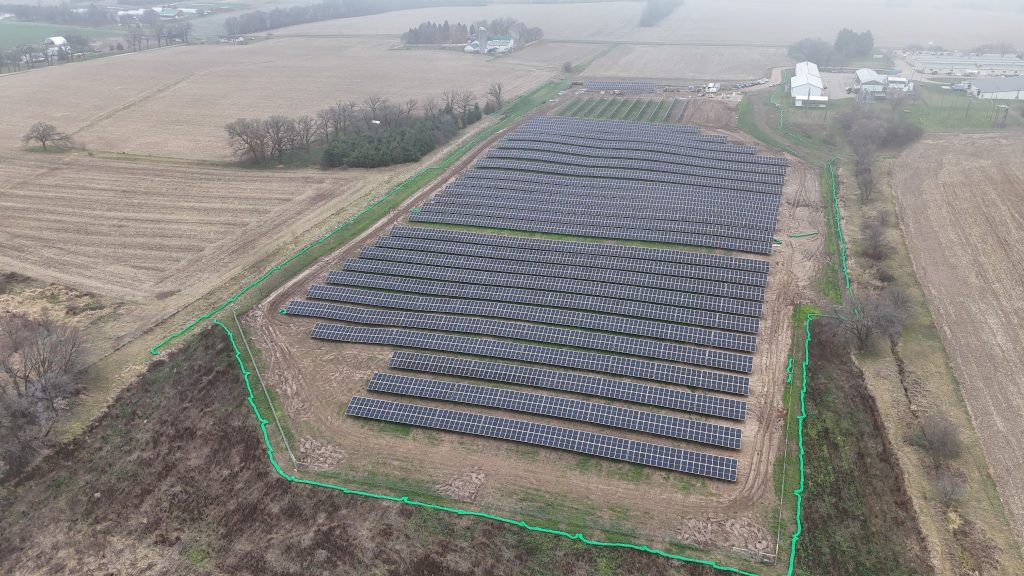
Agrivoltaics is a dual-use technology where solar arrays and agricultural activities are in the same location. According to the U.S. Department of Energy (DOE) Solar Energy Technologies Office (SETO), research in dual-use technologies broadly supports the goals of both improving the affordability, performance, and value of solar technologies and establishing a domestic manufacturing base.
Optimizing site selection and solar array design for both energy and agricultural production can reduce soft costs, such as those associated with permitting, and enable stakeholders to more fully consider trade-offs, leading to outcomes that sustain Wisconsin’s agricultural tradition while powering its clean energy future.
Benefits of Co-location
Solar arrays can be co-located with land uses that enable innovative business practices, agricultural production and/or ecosystem services. Business practices could include developing farm equipment or techniques for dual-use solar arrays, hosting educational tours, allowing for recreational uses, or other activities that create value to the landowner and/or community. Agricultural production may be broadly interpreted to include crop, horticulture, hay, or livestock production. Ecosystem services generally include land-use practices and policies that improve long-term soil quality, water quality, biodiversity, and planetary health.
About the Project
The UW–Madison Kegonsa Research Campus solar array is part of Alliant Energy’s Customer-Hosted Renewables program in which Alliant Energy partners with customers to host an Alliant Energy owned solar farm or other renewable source in exchange for a monthly lease payment. The array features three distinct types of racking and various spacing between rows of the solar array to facilitate research, education, and demonstration. The 2.25 MW (AC) / 2.87 MW (DC) solar array will produce the electricity equivalent of about 450-500 Wisconsin homes. Electricity produced by the array will be delivered back to the electric grid. Renewable energy certificates from the array will be retired bringing our institution closer to our clean energy and sustainability goals while bringing our students, staff, and faculty closer to clean energy.
The array is located on 16.44 acres (6.65 hectares) of a larger 280-acre (113 hectare) research campus located near the UW Physical Sciences Lab in Dunn Township, County of Dane, State of Wisconsin, USA.
The array is not open to the public on a daily basis. Guided tours are available. To inquire about a tour or hosting an educational event at the array, please contact us.
2020 – Initial discussions for an agrivoltaics solar array were started.
2021 – An Environmental Impact Assessment was conducted to assess potential adverse impacts to human health, wildlife, or the natural environment with a Finding of No Significant Impact (FONSI).
2022 – In April, a campus information forum was held where students, faculty and university leadership discussed potential research and educational goals and objectives for the proposed array. While siting and designing the array, the Alliant Energy and UW–Madison project team incorporated input from university facility managers, researchers and students, local and county government, recreational users, neighbors, and the current agricultural tenant about the location, size, and configuration of the array. A lease agreement to develop the solar array was finalized in May.
2023 – Additional planning and permitting was done to finalize site details and prepare for construction.
2024 – Final permits were secured and construction was initiated in September. Construction of the modules and racking was completed in November.
Spring 2025 – The array is energized.
Solar Modules
The 2.25 MW (AC) / 2.78 MW (DC) solar array features 5,424 bi-facial solar modules (often referred to as panels). Bi-facial solar modules capture sunlight on both sides to enhance energy production. This design is particularly effective in winter, as it capitalizes on sunlight reflected from snow.
Manufacturer: Heliene
Model: 144HC M10 SL Bi-facial Module (144 Half-Cut Monocrystalline 520-540W)
Website: https://heliene.com/144hc-m10-sl-bifacial-module/
Racking
There are three types of racking at the array to promote awareness, education and research.
| Area (m2) | Module Count | Orientation | Tracking Mechanism | Estimated production (AC) |
| 1 (2023 m2) | 144 | South | Elevated Fixed Tilt | 50 kW |
| 2 (8093 m2) | 480 | East-West | Single Axis | 200 kW |
| 3 (56,414 m2) | 4800 | South | Standard Fixed Tilt | 2000 kW |
| Total (66,530 m2) | 5,424 | 2,250 kW |
Elevated Fixed-Tilt
The first section includes 2 rows with 72 solar modules each (144 modules, 50 kW total) mounted at a 25-degree angle on fixed-tilt racking facing south with a module base of 8 feet (2.43 meters) extending to 14 feet (4.27 meters). The elevated modules are well-suited for education and demonstration.
Single-Axis Tracking
The second section includes 10 rows with 48 solar modules each (480 solar modules, 200 kW total) mounted on single-axis trackers facing east-west with a torque-tube pivot height of 5 feet (1.52 meters). The single-axis trackers are equipped with a motor that adjusts the panel angle on a pre-programmed algorithm designed to rotate to track sunlight for maximum exposure.
Standard Fixed-Tilt
The third section is located on a south-facing slope to maximize solar exposure throughout the day. This section includes 24 rows with 200 solar modules each (4800 solar modules, 2000 kW total) mounted at a 25-degree angle on fixed tilt racking facing south with module base of 2.5 feet (0.762 meters) extending to 9 feet (2.74 meters). Within the third section, row spacing varies between 17 ft 6 inches (~5.4 meters) (considered standard spacing at this latitude) to 31 feet 8 inches (~9.7 meters), allowing for experimentation with different shading and usage between rows of solar modules. A goal for construction was to minimize soil disturbance through earth moving at the site, therefore the figures above are average and approximate as the natural terrain varies throughout the array.
Decommissioning the Solar Array
At the end of the operational life of the array, the solar modules, racking and electrical equipment are designed to be able to be removed so the area can be repurposed.
Ground Cover Seed Mixes
Two different seed mixes were planted at the site. Within the solar array, a native seed mix was planted. Around the perimeter, a native pollinator seed mix was planted.
Compatibility with Existing and Future Farming Uses
Within the solar array, several rows are spaced to accommodate future agricultural or horticultural activities.
To minimize disruptions to existing farming operations at the larger site, the teams from Alliant Energy and UW–Madison walked the site with a member of farming operations team at the site to better understand the space requirements needed to use their farming equipment. This resulted in a 65-foot (19.8 meters) buffer area to allow for agricultural equipment (such as tractors or other implements) to pass near the array without damaging either the agricultural equipment or any equipment associated with the solar array.
Compatibility with Recreational Usage
The array was designed to accommodate a multi-season recreational trail used for hiking and snowmobiling in the winter.
Decommissioning the Solar Array
At the end of the operational life of the array, the solar modules, racking, and electrical equipment are designed to be able to be removed so the area can be repurposed.
Site selection factors for this project included:
- Environmental Impact Assessment (EIA) resulted in a finding of no significant impact (FONSI) to people, wildlife or the immediate environment.
- Located near existing university facilities and infrastructure.
- Uses 16 acres of interior area with 265 acres continued usage as before.
- Located on south-facing slope ideally suited for solar.
- Avoided impacting more than five (5) acres of prime agricultural soils.
- Avoided wetlands and wetland setbacks.
- Use of vegetative buffers to help shield views where requested.
Researchers from UW–Madison are already collecting baseline data at the site. As it moves into full operation, the campus is to host a variety of research projects and use the site for student education and engagement. Check out our current projects with topics including:
- Forage for solar grazing
- Long-term monitoring of soil quality
- Microclimate
- Agronomic productivity
- Pollinator monitoring
- Migratory birds and wildlife
- Horticulture
Resources
In the News
NAAA Dual-Use Plan of the Year Finalist. NAAA 2025.
Badgervoltaics works to make solar more accessible to Wisconsin farmers. Beth Stacy, The Badger Herald, February 27, 2025.
Badgervoltaics: Agrivoltaics Research at UW–Madison’s Kegonsa Research Campus Solar and Agriculture Pilot Project. Nelson Institute for Environmental Studies Issue Brief, January 2025.
Agrivoltaics Part II: UW Kegonsa Solar Project. The Cutting Edge Podcast Episode #46, UW Extension 2024.
“Wisconsin Researchers Are Looking at Ways Solar and Agriculture Could Coexist on the Same Land.” Joe Schulz, Wisconsin Public Radio, 5 May 2023